Bruin the Bear, dazzling costumes, and advice for future panto stars!
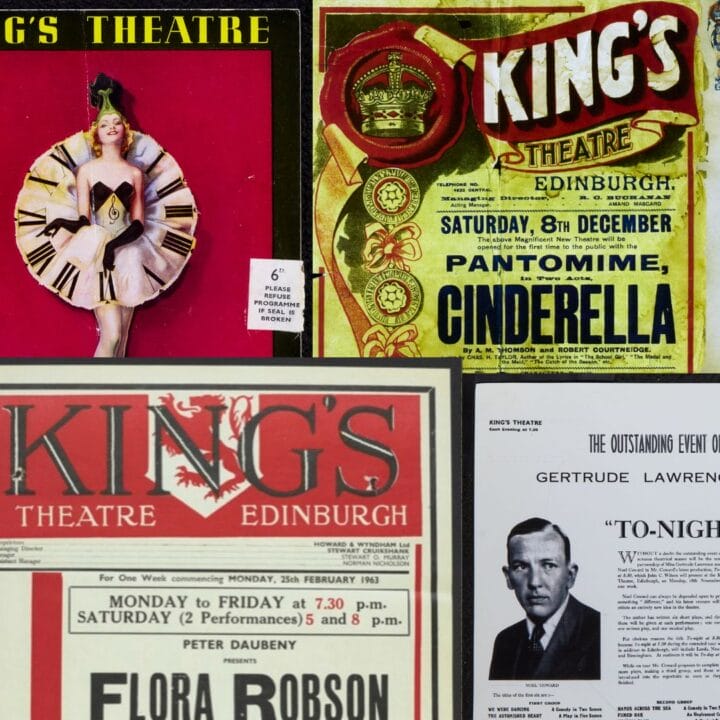
Explore our highlighted excerpts and quotes from some of our favourite interviews. Check out our participants and their highlights this season.
Our featured stories:
Annette McCann: Bruin: the bear that missed the panto
Rhona Cleland: Dazzling costumes
Iain (Stuart) Robertson: Advice for future panto stars
Bruin: the Bear who missed the panto
Annette McCann
When reminiscing about her first pantomime, Annette recalls being unable to bring along her favourite stuffed bear. She promised she would tell him all about it. This story sticks with her today.
05.00
Interviewer
So, what’s your first memory of being at the King’s?
Annette McCann
Well, when I was, when I was, I think I was maybe about three. I’d been to the King’s before that, but I didn’t remember, you know, I don’t remember any of the Lionel Blair story, I’m afraid, but eh I had [noise from seagulls outside] a teddy bear and it was called Bruin.
It was a he, he teddy bear. He was called Bruin. And eh, so, I was being taken to see the pantomime and of course, it was always a thrill to see Dad standing at the front conducting the orchestra and the orchestra was big in those days, it was really big. They had a harp, you know, and all sorts of, it was a proper orchestra. You know, and over the years, it just got smaller and smaller and smaller and smaller.
But there was eh a lovely lady who used to play the harp and her name was Miss Harper! And she actually gave me a lesson once, and I loved it, but anyway, since then, piano has always been my instrument.
But anyway, so, I had a teddy bear, and I said to my Mum, “can I take Bruin to see eh the pantomime?” She said, “no, no you can’t do that”. I said, “oh, oh,” so I had to have a word with Bruin because he was very upset.
And so, I tried to explain to him that, you know you wouldn’t be able to come, but I would tell him all about it that night when I came home.
Well, when I got home that night, I was far too tired, and I didn’t tell him. And I didn’t tell him all about it the next morning. And you know, how old am I now? 67 on my next birthday and I still beat myself up about it. Not telling the teddy bear all about it [laughs] when I made a promise to him! He was. He was. He was… He wasn’t a bear. He was a person, you know.
So, it’s amazing how things have changed, actually since, um, since Dad first started at the…, he first started at the King’s in 1953, I think, and I was born in 1957.
So, Tollcross was a completely different place and eh when, when he used to take us up to his office, because my Mum was in hospital quite a lot when I was younger so, Dad used to look after us or, or he would farm us out to our family who lived in Tarvit Street, and they would look after us. They were great. They taught us all sorts of wonderful games and everything. They were lovely eh, but so, it…
but I do remember walking round to the stage door which is along that funny little crooked path and you go between the tenements, the King’s on one side and the tenements on the other side and if you looked up, there would be these, you don’t see them anymore, but sort of pulleys that, they, they come out of windows and you would hang your washing on them and they were controlled by ropes and, you know, Yeah, little wheels and that sort of thing. So [elevator noises] you would see all these. You would see all these across the sky eh when you walked along and I remember asking what they were because it was no tumble dryers in those days, you know, yeah and there was a met… a series of metal staircases going up to my Dad’s office.
It was a way up in [metal squeak] the in an area away, up at the top of the building and it was your feet. You, they were very noisy, and we were always told to keep the noise down when we were going up these metal stairs, you know, um and then we got to his offices eh and um it was all floored in lino.
Eh, you know, like sort of après-war, just post-war lino, that’s what all floors were covered with in those days because, you know, the money was scarce and everything that was just lino.
Oh, so it was this… It was the same lino? It was a sort of a muddy brown colour and the muddy brown colour and this muddy brown colour went right through these little series of offices, and they were dusty and cob webby, and there was piles of scores lying about the place and lots of ancient old telephones and telephone systems, probably going pre, back pre-war. That’s where they were all stored.
And my Dad used to make his coffee on a little…just a little gas ring and when you turned it off and took the coffee back into his other little offices… little room …ages after that, it used to pop and give my sister and I a terrible fright.
“All the people I remember were people like Stanley Baxter, Jimmy Logan, Fay Lenore, oh she was beautiful. I think she used to be a dancer in her younger life. And then she came back as Peter Pan, and they used to have her flying about on a wire, you know, which we thought was fantastic. Rikki Fulton, Jack Milroy, Hector Nicol who was a particular favourite of mine because he was so funny, Una McLean, Alexander Brothers, Andy Stewart, all these people”Annette McCann, daughter of Musical Director, Patrick McCann
Dazzling costumes
Rhona Cleland
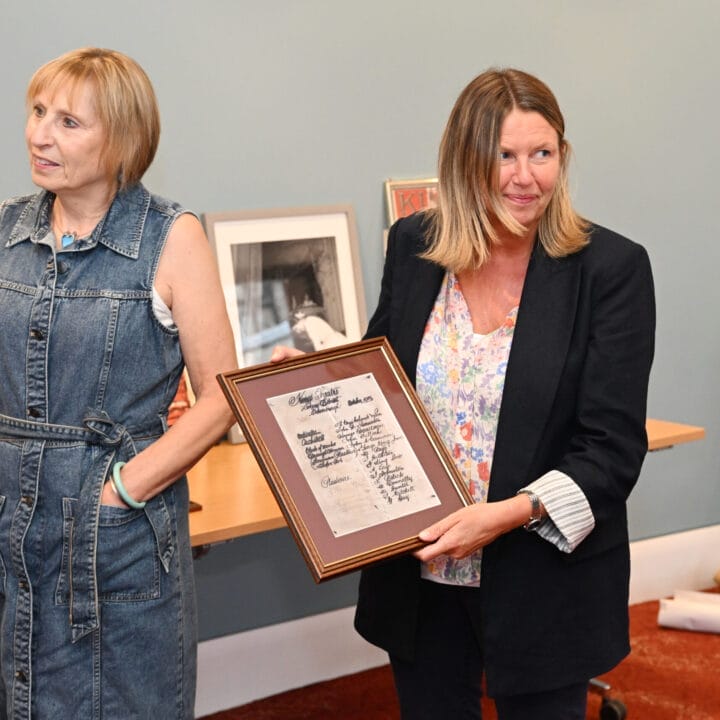
Rhona starred in her first pantomime as a dancer in the chorus at the King’s Theatre in 1974. After donating stage photos, contracts, and memorabilia, she shared her favourite stories from her time working to perform and promote the pantomime.
Rhona Cleland:
Thinking back, I remember particularly Mother Goose and there was six girls and six boys. so we always had partners. And I think that might have been the start of the collaboration between Glasgow, Edinburgh and Sunderland. We went to London to be fitted for costumes. The costumes were absolutely out of this world.
06:11
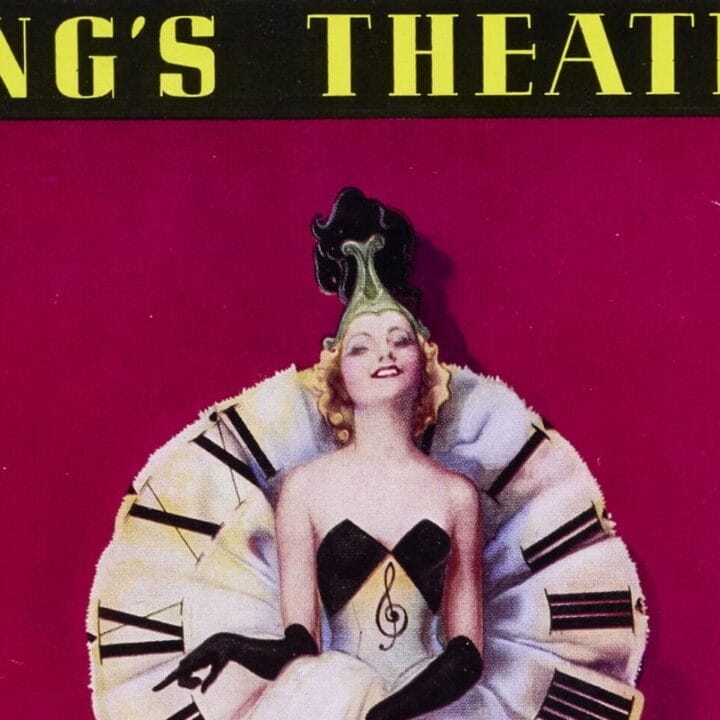
To things like, we did a number in the most beautiful Regency costumes with bonnets and every couple was a different colour, pink, lemon, green. We had the shoe, it was in water silk, the shoes were cream water silk, we had gloves, the guys top hat, it was absolutely stunning. We did one singular sensation in the finale with white feathered costumes, we were like showgirls and Stanley at the end of that, that was the first act finale and he came down in a Fabergé egg which came forward to the stage opened up and he was in it and then he flew and he had this huge skirt and then eventually the skirt dropped and he was in his knickers at the top there always had to be a laugh but I mean everything with Stanley was amazing do you know what I mean everything he knew. He wasn’t an easy man to work with, but very particular and everything was, he knew exactly what everybody should be doing whether you were a dancer, a singer or what.
Advice for future actors
Iain (Stuart) Robertson
Iain, better known in the professional world as Stuart Robertson, performing in a range of roles from Gandalf in the National Tour of The Hobbit, to playing Baron Hardup in last years’ Cinderella pantomime. Learn his advice for actors wanting to grace the King’s stage in the future.
31.02
Interviewer:
So, what advice would you give to a student who’s interested in drama in Edinburgh moving forward?
Stuart Robertson:
What I would say is go and see as much as you can. Um it’s not cheap, of course not, but there’ll be good stuff in a pub theatre, above in a room, a fringe area, somewhere, and you can learn what to do as much as what not to do by going to see it. Get involved with people. Go in ah small companies like that, even if you’re a student, go in and talk to them and see if there’s a… can you get in, can you be in on a rehearsal, could you… and it’s just getting yourself involved and taking advice and you can actually, by watching certain people, you think they’re good. Why are they good? What are they doing that I’m sitting in an audience watching and it’s pulling me in and studying them and thinking, right, oh I see. And the thing is, quite often it’s confidence um but as I said before, they’re listening. They’re listening and don’t act, react to what’s ever given to you. Reading the script, read the whole script, not just your bit. Because people will talk about you. [sniffs] And you learn more about yourself by what other people say about you. And you think, oh right, oh I see, gotcha. Just don’t wait for the read-through [laughs] around the table to find out, he says from experience! Um and you think, oh right, and that influences what you do.
But basically, it’s getting out there. And, just, if you wanna do it, you’ll wanna do it. And everything that comes flying in your face to stop you, won’t stop you. If you sit there and say, “oh well, you know, I thought I’d give it a year, and then it doesn’t…”, well, you may as well not start. Because it ain’t gonna happen like that, unless you have got a big edge, or you’re lucky, and you’re suddenly getting something, and you are the thing for a while. Until the other one comes up, who’s younger than you, and fills that role, and you’ve suddenly got, well, I’ve no experience of being that older person yet. But in the theatre, you get to play different things, and you’ve got somewhere to go, um and getting up there and being frightened. It’s terrifying at times. You’re standing there, I mean one time I was doing something, and I thought I’m not off this stage for nearly two hours. I’ve only had 10 days rehearsal, why am I doing this? You know? And then something kicks you in the bum from behind and you walk on stage and it’s there and you start. There’s no way back.
Those people have paid their money, you’ve said you’ll do it, you do it. And you’re terr… you’re absolutely terrified, but it calms down and once you’re into it, you think that’s fine, that’s fine, that’s fine. And then as the, as the production runs on, you get more relaxed and more relaxed because you know what’s coming and you feel… But then something I’ve found myself as well is don’t cherry pick.
Interviewer:
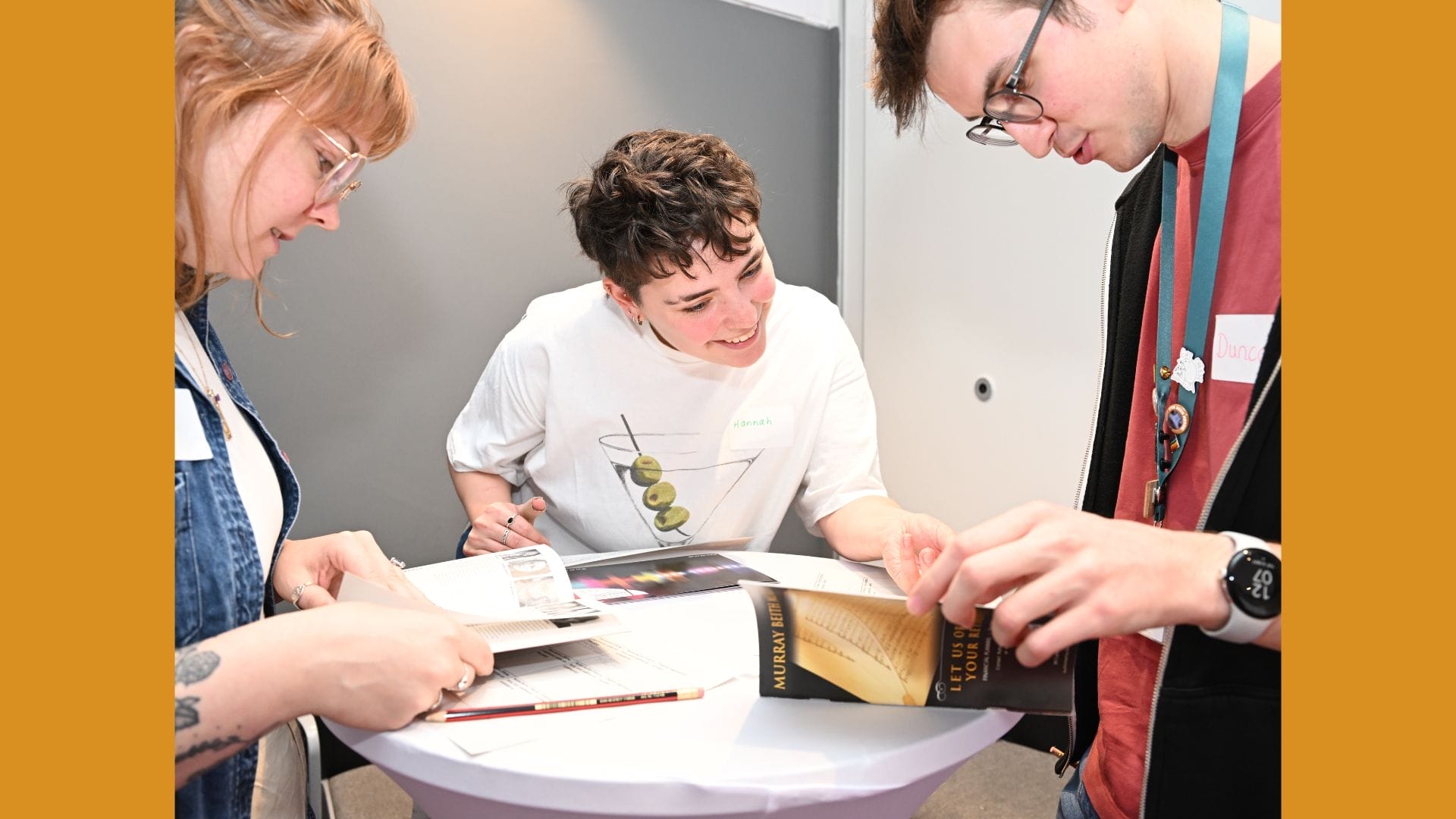
This recording is for the People’s Archive as part of the King’s Theatre Heritage Project. The date is the 3rd of December 2024, and I’m going to sit down and speak with Ian Stuart Robertson today. The time is 1.44 and we’re going to begin the interview now. Please state your full name and date of birth.
Stuart Robertson:
My name is Ian Stuart Robertson, but everybody knows me as Stuart and my date of birth is the 24th of August 1961.
Interviewer:
Where were you born and raised?
Stuart Robertson:
I was born in, on, in Greenock on the West coast of Scotland, which is about 26 miles South-West of Glasgow. Sorry, what was the other bit? [laughs]
Interviewer:
Did you have any siblings growing up?
Stuart Robertson:
Yes, I had a brother um who unfortunately has passed away so there’s only myself and my father left. Um, a non, a non-theatrical family, there was nobody in it. I’ve been doing this silly job for 42 years now um and there was no one. I think I learned, ah especially on the West Coast in a family unit like that with your aunties and uncles, of how to tell a story. Because I remember listening to my mother, we’d go on a Sunday, we’d go to my, my old auntie’s house and we’d sit there and of course you’d sit around the fire, which was an open fire, and as children, you’d be seen and not heard, so you sat in the corner on, on the small seat. You know, you’re getting bigger, but you’re still sitting in the small seat that they’ve got for you, your knees are round your knee, are round your neck. And well, they talked and we would discuss everything for the week that happened and who they’d seen and all that. And you learnt at an early age and especially when my mother was a great kind of talker of stories, a blether as they say in Scotland, and she would actually, you could tell that there was always a beginning, there was a middle and there would be an end to the story, she would sum it up. So I kind of learnt that quite often if you’re gonna tell a story, have the ending first and work your way back, because there’s nothing worse than getting there and there’s nothing to finish it with. Um and I think that happens a lot of time with people. If you, if you listen to a good story, there’s always a good description, but it comes to a conclusion.
[coughs] So yeah, that’s how I kinda learnt working with people. And I went to school, and the reason, one of the reasons why in quotes “I became an actor” was you got out of double French and things like that to rehearse um the, the, the musical that was being done, Camelot, or something like that. I think my first part was Sir Dinna Dan’s um sort of assistant, I would sit there polishing a shield. But that got me out of double French while they rehearsed. And eh then that company became a small amateur group, a youth theatre called Oracle and we used to rehearse two nights a week down in the big Cragburn in Gourock and it was a great social thing. It was also because my father was a sailor on the , on the Clyde, and I was never very good at it and I was always the smallest one and I was stuck up the front of the boat, getting the wash over me. I was freezing, I was cold, my hands were stuck to the ropes, I could hardly pierce them off, peel them off in the middle of the Clyde, and I looked in and I could see the Cragburn Pavilion on the shore with lights, and it was like there was happiness pouring out the top, you know, like you see in a cartoon with musical notes and laughter, and here’s me stuck, and I thought, you know what, they rehearse the same days as the racing nights, and my friends are in there, so I said to him, much to his chagrin, I said, “I’m gonna go and do the acting thing as a hobby”. “Oh, that’s fine, yes, no, don’t worry, I’ll get someone else, yeah, we’ll find another crew member to sit up the front and take the wash”. Um so that was one of the reasons why I became an actor, was to do that.
And it was extraordinary in a way, because we were doing, we’d done a few shows, and I’d, I’d the coach driver, Dinna Dan, or was it Landau, the coach driver, and the Dracula Spectacular, and things like that. You had the one little part, and it got you built up in a certain amount of confidence. But the thing was, we used to, after, it was like the whole social thing, and the guys were older than me, ah and the girls and all that, and of course, you’d say something, and nobody would kind of listen, if you’re in a group of people, because you weren’t the funny one, or anything like that, and you’d say something, you’d go, ah, and you’d be kinda ignored in amongst who’s the funny one in the group and all that, and they would take over. Then I suddenly realized, because they were doing Joseph, and it was the woman who ran the thing, Carol Leith, and Carol said, “you should have, you’ve got a good voice, why don’t you audition with us for, for Joseph?”
So we auditioned, and I got the part of Joseph. So there I am, up there singing, and the next week I’m sitting around a table of people at the back and I said something and they stopped and they turned and listened to me. And I thought, you didn’t do that last week. And I thought, I see. Right, gotcha. And so that was a very interesting part of my life where it swivelled. Um and then, so I was there and one of the girls I was going out with at the time, she went to a thing called drama school. And I thought, oh, what’s that? You know, little did I realize there was about 2000 people applying. There was only 20 places.
So I went to the Royal Scottish Academy. So the guy who’d, who’s been in charge of it, a guy called Ted Argent, had come down to see a production that we’d done. So he, and he done a lecture with us on masks and I sat and chatted to him and all that and then when I went to audition, who happened to be behind the thing, but he’s there as well with all the others. And all the usual thing of, you know, what’s your Shakespeare piece, Act 5, Scene 5, Pomfret Castle, Richard II. I’ve been studying how I may compare. And because you know inside out you’ve done it for, you’ve learnt it months and months and months, so you couldn’t forget it. I mean, it just came pouring out. And I did something for Davison The Caretaker as well. Oh that was big of me and I was only about 18 or something at the time and 17 and so I did that and I got that, in fact there was a thing there was my mother I’d be, I was in Uttoxeter of all places on holiday and I knew that in those days it was a letter would arrive at the house and the letter arrived and I phoned her up from this phone box and I’m pumping two pence pieces into the phone box. And I said, “did, did my letter arrive from drama school?” And she went, “yes, it has”. And I said, “oh, ah”. “Do you want me to open it?” And I said, “yeah, go on, open it, open it. Read what it says.”
So I’m standing there in this letter box, this telephone box, which kind of had a smell, an aroma about it. And I, she said, “do you want me to read it?” I said, “yeah, read it, on you go.” She said, “Dear Stuart, thank you so much for ah auditioning for Royal Scottish Academy of Music and Drama. Unfortunately, ah this year we won’t be able to offer you a place.” And I went, “oh well never mind, maybe I can try again.” And she went, “how do you feel? “I said, “well that’s all right, you know I’ll try again”. She said, “do you want me to read you what it really said?” … And I said, “what do you mean?” She said,” I’ll read you what it really says. Dear Stuart, ah we’d like to offer you a, a, a term at the Scottish Academy for three years. With great pleasure, we’d like to… “ Wow, she said, do you remember how you felt when you didn’t get in? And I said, “yes”. She said, “never forget that. Every time you feel low or you feel… Remember, you’re only 20 out of 2000 people and you got there. And that’ll keep you focused, because the disappointment you felt of not getting there…”. And it did stick with me.
And it was a great kind of education in that way, because you got a chance to fail, really, at drama school. Um you could make, you could mess up so much. Then I went straight into professional theatre at Perth as acting ASM. And I went in there on the 12th of August 1982 ah as an acting ASM on, I didn’t speak to the third show, which was Cider with Rosie, and I went all the way through and I left Perth, overlapped, went up to Pitlochry Festival Theatre in 1983, did the whole of the season there, they gave me two lead roles up there, then I overlapped again with Good by C.P. Taylor and came back down to Perth, and I finished off playing ah Fancourt Babberley in Charlie’s Aunt on in April 1984, and that was my first day off, really. [Laughs] Apart from your usual like Sunday that you would get off, but that would be with reading lines, I would be learning lines, you know, that, you never really got a day off. Because you’re rehearsing during the day, um you’re performing the show that’s on at night, you’re rehearsing the new one during the day and you’re reading the one after that when you go home. So that’s what, that’s what repertory was like. And so luckily I was young enough to do it, um because the brain is just a maelstrom really. And you’re going on, and so once
I finished I thought, [exhales] there we go, that had been a long haul but I had the experience and the technique now to actually go and attack most things I was asked, part-wise, role-wise.
09:20
And then I went over to Belfast and I worked at Lyric. They asked me to go across there and I worked at Lyric. I was there for five months [clears throat] during the Troubles, ah so it was an interesting time to be there. So you had to be very careful about where you went, what you did, what you said. Um but again, a fantastic experience to do Irish plays in Ireland during the times like Translations by Brian Freel, fantastic piece. Um George Bernard Shaw, The Millionairess, Shakespeare, Comedy of Errors, what else did I do? There was Moon for the Misbegotten, Eugene O’Neill, so there was some fantastic stuff. Again you’re building your technique, building your technique and the lovely thing was as well I could come back and I could do shows and then I can do pantomime, you know. [Clears throat] And you can go up there and you can play pantomime Dame. This is my 32nd pantomime. Well, I class it as Christmas show because not all of them have been pantomimes. I never really think of ah Wizard of Oz as a pantomime. And I’ve done that three, four times. Peter Pan I did five times, but again I didn’t really consider that as a panto because it was a full Peter Pan stuff with the flying and the kids at the top and Never Never Land and all that. There was comedic pantomime elements, but it wasn’t a case of like, it’s a panto, there we go. It was the full story with an actor, a brilliant actor called Brian Blessed. And Brian played Hook and I played… I worked with him three times. A lovely, brilliant man. And oh, I like him, [mimics] Brian and his voice, but he’s such a sensitive man, and a brilliant actor, and a wonderful human being. Really is, all that, bless him, what a fantastic man. And so that, that’s what I’ve loved, is the fact of, it’s, it’s all I’ve ever done, really. Um and as I said, I’m the voice of the buses at the city sightseeing in Edinburgh. I’ve worked in every theatre in Edinburgh, I’ve been extremely lucky.
11:22
I’ve been at the King’s several times and the two that I can remember were was A Wee Touch of Class with Rikki Fulton. Ah it was away back in the ooh 2000s or 90s, 0h, do you know what? Ah ‘89 or something like that, it could be, they all kind of fold in. But I having said that because most of the cast have now gone. So we did, A Wee Touch, with um of Class with them there and then we, it was on tour as well, we did Aberdeen. And the other time that I can remember was working with, with um Jimmy Logan, doing Run for Your Wife with Mary Riggins, Russell Hunter, Ann Fields, Billy Armour. And so again, doing the farce thing there. And was such a, it is a wonderful theatre. It’s so close to you and warm, and they opened up the top tiers that hadn’t been open for a while. Um and I’m so glad that they’re actually, that it’s going to reopen, it’s been looked after and cared for, and it’s going to be a fantastic theatre when it’s open again.
12:23
Um. So I worked there, I worked at the Playhouse, I played Gandalf in the National Tour of the Hobbit at Playhouse. Um that was a beast of a place. Um I don’t know, about two and a half, three thousand or something like that. And we didn’t have throat mics. We had rifle mics at the front. [laughs] And so, and being Gandalf, you’re not really off that much. [Clears throat] You’re there most of the time. And you’ve got to fill that space. Um and all, we’ve got the hydraulic systems. In fact, it used to take them two days to set it up. We would finish on the Saturday, they would travel on the Sunday, they would take Monday to fit the whole thing up. And we’d possibly do a Tuesday night, but we’d have to have a run through on the Tuesday afternoon. But that was a beast. The old Traverse, the new Traverse, ah Lyceum, we did On Golden Pond there with Ali McCallum, and it was… oh The Netherbow, umpteen times, with Fifth Estate and companies like that with new writing. Um the Church Hill Morningside, Leith Town Hall. Um and I did one of my favourite ones as well. I did the Scots Quair, which was Sunset Song, Cloud Howe and Grey Granite, the Lewis Grassic Gibbon books. And we were the first to do it. We started off doing Sunset Song ah for the Mayfest many years ago, I mean ‘96 or something like that. [Clears throat] And we did it and everyone really loved it. It was done as a kind of physical theatre, musicians and actors and we all melded into each other. You would be there with the dancers, having to support them as they throw their legs at you, you know, and if you don’t they’re going to hurt themselves. It’s real trust and dancers really do trust each other, they have to. And you’re like that and the musicians said to me, one of them came up and said, “do you play any instruments?” I said, “no”. He said, “well, I’ll tell you what, come here”. And he’d a double bass. He said, “right, put your finger there. You know the five and a dice?” I said, “yes”. Well, one, two, three, four, and then that one in the middle. And I’m going, and he left me alone for about two hours. He said, “you practice that”. And then he came back, and I did. He went, “that’s fine”. I started playing it, and then they started playing around me. Me just doing that and I thought how wonderful.
They’re allowing me into their world and they would come to me and say, “I’ve got some lines. How do I say it? What do I say?” I said, “don’t think about it too much. Just you’re in the middle of a scene. The best thing for anyone [clears throat] who’s acting in that way is don’t act, it’s react. Listen”. “If someone’s talking to you, what do I do with my hands?” I say, “well, what do you do with your hands now?” “Nothing, they’re at my side”. “Well, that’s where they should be. Don’t wave at people. Listen, because as you’re standing there, the focus is on the person who’s talking, so you’re listening to them. And you’re concentrating on them. And when it’s your turn, you don’t, you give, you don’t leave a gap.
As in conversations with people, there is a slight overlap quite often. In conversations. Be ready. So as you talk, you can talk over the top. There’s never that, don’t breathe in before you talk. You’ve breathed in before and you’re ready to go. And so it just goes, boom, boom, boom, boom, and it pops along and the whole thing has a beginning, a middle and an end. Like most things, there’ll be a reason for the scene being there and then there’ll be juxtaposition at the end and it’ll move on to something else but it’ll have an ending to it for a reason. It won’t just, poop, come to a halt in the middle of a sentence.” And so they’re watching and listening, [clears throat] the producers and the dancers, and then it comes to their bit and then they begin to understand. And then you ask them about physical theatre because you’ve got to be fit in these things. And representations. And there was the wonderful thing of my eye opening because I was a literal, a literal person [clears throat]. And I thought, how are they going to do like ah the First World War and things like that? And I just, we were sitting down, there was a moment in it where all the guys like from the PALS regiment from the village had gone to, had gone to war. And it’s very simple, we had an open stage. And I just sat there, it was one day, and it was the choreographer, Andy Howard, brilliant man. And we were rehearsing in a school hall kind of thing, and he saw a bench. You know, one of those school benches you get in a gymnasium, with kinda the rubber ends. And I saw him look at it. And we were all talking, he went over, he picked it up, and he found the centre of balance. And he found where it balanced. [Clears throat] And he put it down. He now knew the balance of it, he now wanted to know the noise it made. So he lifted it up by the far end, he let it drop and it went doof, and we all stopped and turned round. He’s still concentrating. He picked it up and he took it by the long way and he threw it, and it went [makes long noise]… It sounded like cannons, it sounded like machine guns, it’s chaotic, cacophonous noise. And that’s what it became. And we were all part of it and that, there was two or three of them all doing that at the same time as we were trying to do the dialogue. And then that wonderful moment of someone mentions it’s Christmas, and or someone mentions… and you know exactly what time of the year it is by they all sorta stop and somebody very faintly starts singing [sings] Should Auld Acquaintance Be… and so as an audience you know where you are you know who you’re with and you can be taken, that’s what an audience loves, let, take me somewhere leave me and let me appreciate and then take me somewhere else and I can just sit and go with you feel confident in you that you’re going to take me and tell me a story. And that’s what I loved about those things.
They were so immense. But yeah, so that’s my kind of experience in Edinburgh. So, what happened was, it was actually done, we did ah Sunset Song, and then everyone loved it. So, they said, could we do Cloud Howe, Grey Granite as well? So, we put them on, put Sunset Song on, and during the day, we were rehearsing Cloud Howe, Grey Granite, the other two books. Chris Guthrie, who goes all, she goes all the way through. So eventually we opened the International Festival, Edinburgh Festival, and we were at the Assembly ah Hall, which is not the rooms, it’s the hall at the top of The Mound, which is the church area in there. I can’t remember the full title, apologies. And um but we would do, on Monday we would do Sunset Song, Tuesday Cloud Howe, Wednesday, Grey Granite, and then the other way round. And on Saturday, we did all three in the one day. So the audience could come with us, from Chris Guthrie being a little girl all the way through to she’s right at the end of her life in Grey Granite. And it was an immense journey for everyone, for us, for an audience. Um I mean, we started about one in the afternoon. I think the last curtain was down about 10 because there’d be a gap of a couple of hours between each one so people could…, but that was a beautiful trip to go on that and that’s what I really loved And that’s one of the things about the Festival. There’s always this different stuff. So that’s kind of my experience of and I’m still, still going strong.
I’m still here. I’m still that I was, I was Dame last year at um down at Nottingham with Shane Ritchie, [clears throat] and we had a good laugh, great fun. And so I just love the diversity and working with different people. And when I do Dame up in Scotland it’s Scottish, when I do it down in England, quite often it’s [does Northern English accent] Northern like, you know, hey, what are you doing? Stop that, come on, come over here, right come on. Because of the ups and downs of the voice, because sometimes you find them in the Scottish accent, it’s wonderful, but if you’ve got English accents and then suddenly you’ve got the Scottish, sometimes it can clang. And a lot of the comedy in panto is to do with rhythm. And it’s all a song and a dance. And if something jars sometimes, if it’s not on purpose, then it can be. So I just do that because it rolls, that accent rolls, and you can get up and down with it. Um I mean, there’s a lot of Scottish guys down there doing panto and Scots, and it works equally as well because people like the variation It’s just a personal choice for me. Um and I feel comfortable in it and that’s that so I do that. I’ve did Dame three times at the SEC in Glasgow, which is another beast of a 3,000 seater, John Barrowman, the Crankies, Marty Pellow. Um lovely people. It’s been it was great and um, yeah, so I’m in Panto all over the place, all over Liverpool Empire, I was Dame there with Shirley Ballas, um Cardiff, all over the country. So I’ve been extremely lucky. And I’m still going strong. Well, I’m still going, don’t know about strong. And this is fantastic, just now.
21:14
Interviewer:
For context, can you tell me about your role in this year’s Pantomime and tell me about the panto?
Stuart Robertson:
This year’s pantomime is Cinderella at the Festival Theatre and I play Baron Hardup, um father of Cinderella. We are a bit poor and I love the fact that they’ve actually updated it to rather than Cinderella which she’s now become, she’s going to college and she’s studying to become a royal advisor. [laughs] I love the way that things move on because that actually makes more sense to kids, a royal advisor, through television than something of my era, you know. Ah she just wanted to get married in my day, you know, but no, she wants to be a royal advisor. And when it comes to the end, she says, “no, we’re not going to have a big wedding. No, you’re going to go to college and I’m going to study. And then we can decide what to do”. And I thought, lovely, good, it’s brought it right up to date! Um and it’s a wonderful production, the production values are immense. Um a lot of the costumes have come from the Palladium before, and so there’s a lot of money being put at it, and it looks fantastic, and you’ve got three brilliant guys up the front there. I mean, you can’t get better.
They’ve been together for so long, they just bounce off each other, and it’s that wonderful thing of having people come back who know each other well. When you start rehearsals, you’re halfway up the ladder to begin with. You know, you don’t have to get to know each other, and they just have their own language, their own banter, ah and they bounce off each other, you know, make each other laugh, and it’s just a lovely, warm atmosphere, and they’re lovely people as well, and the atmosphere backstage is fantastic. Um and it’s just the whole thing is about the show, making the show as good as we can for the people and you go out there and you give it 100% every show you do, nobody ever pulls back. There’s a lot of people come to you, two shows a day, six days a week and sometimes you can look at people on the eleventh show and they’re just sitting and thinking, just like [huffs], and then, bang, up they get and on they go. Um and it’s just like, because it does after a while. So, you try to get out between shows just to get some fresh air, because you don’t get any sunlight, by the time between shows it’s usually dark.
So, I myself try to get out for a walk in the morning just to get some daylight, because quite often you don’t see it all day when you’re arriving, when you’re in, and you’re in all day. Ah but this is, it’s a fantastic production. Production values, the people in it, the whole thing. The backstage crew are wonderful. I mean, they’re just chirpy, and you can tell, when I’ve been around a long time in that way, this is my 32nd panto. I’ve done over 100 productions in the theatre, ah over 42 years, and you can tell as soon as you walk in, as soon as you walk to the stage door, there’s a happiness. You can feel it in the building, and you think, good, I know this is going to be a good one. It’s warm and everybody’s working towards the show. The show is the important thing. And there’s no egos flying about, it’s about doing the show. Um and that’s…
24:07
Interviewer:
That leads me to my next question actually, which as an actor, you’ve performed in so many different venues, how does the physical space impact your performance?
Stuart Robertson:
It’s often a case that the thing you have to w, not worry about, but to take on board [clears throat] excuse me nowadays, is when I first started, there wasn’t any microphones. And so you’ve now got to fill a space physically, [clears throat] but vocally, you’re talking normally. So it’s like patting your head and rubbing your stomach. Because in the past, with no ah, you learnt how to, if I was doing a production at the King’s, with no, you learn how to actually drop your voice [projects voice] down and you talk from your stomach so it comes across and as in this room at the moment you can hear it bouncing off the back. I’m saying exactly the same thing but I’m just having to raise the voice so the person at the back of the stalls can hear me.
Now [speaks softer] you can do it to that because the microphone is stuck there but you’ve got to let the people at the back see what you’re doing. If you’re going to gesture, gesture. You know, don’t just go, because I remember going to see something, I won’t say what it was, and I was at the back of a very big space and the actors were very good actors, but it was happening within about a foot of each other and it was really minimal and they had the microphone on and I could hear what they were saying, but I, I couldn’t tell how they were… It was like watching, watching a radio. I was trying to get the story and their emotions by, through their voice, whereas if they were to physicalise a bit more and bigger, I could understand. It’s a strange thing. I remember doing Shakespeare many, m-a-n-y years ago. It was a production. And one of the directors actually said to me, he said, “I tell you what, it’s a big space and all that, and regardless of what anyone says, after 10 minutes you try to translate Shakespeare”. And it was A Comedy of Errors, was it? I think it was. And um so you start, he said, “well just talk in numbers. Now what’s the gist of this scene?” And I did, so on you go. So, you have to go, “one, two, three, four, five…, six, seven…, oh eight, nine, ten. Eleven, twelve, thirteen, fourteen, fifteen”, so you’re getting the intention, now pop the words on, with and they will be they’ll suddenly come to life because you’ve got that you know what you’re talking about and those words will fit beautifully and so as long as you understand what you are talking about and then you can gesture, because that person at the back of the hall has got to be able to see as well, if it’s that size.
I’m sorry, I know this is radio and I’m being really minimal with my gestures at the moment. It’s difficult for an audience to pick it up. And that’s why sometimes you’ve got these big venues now that have got screens, so you can see what’s going on. But in my day, you stood there and when I first started, you filled that space, because you were taught how to, by dropping your voice, by being able to do it. And being emotional with such a big voice as well, there’s a skill in that, rather than just being minimal and start… You know, it’s a skill that’s… No, I mean, sound men love me, because I, I talk loud. The sound guys say, “we love you”. Because some people who are used to being on television all the time, can be… they’re just talking to somebody and that’s fine, but this is a big space. Um so they’ll get these different levels going, this one and the other. Um. So yeah, and and, that’s the interesting thing about it as well, is how to actually adapt to each space you’re in. And this is a wonderful space as well, the Festival Theatre. But yes, as time has gone on, my way of actually working has had to change in that way. As I say, in the Playhouse, we didn’t have any, I was playing Gandalf on the, the national tour of the Hobbit, I wasn’t hardly off for two hours and we didn’t have any throat mics, it was just rifle mics at the front and that is a big space and you’ve got to fill it and you’ve got to make sure that the person at the back of that big space knows what you’re talking about and can see your gesture.
Um so yeah, it’s an interesting way of actually doing it and I’ve gone through several stages or incarnations as an actor to fit the new styles and the new sounds. Um, I’m I’m still a believer though, I mean it doesn’t matter how wonderful a microphone can be, it’s still a woofer and a tweeter. You’re still getting a kind, you’re getting it, but it doesn’t, you go into a small venue and you watch an actor who knows what he’s doing, or even a bigger venue, and they will physically affect you emotionally [clears throat] because what you have is your mouth to ear, as any human being is, there’s nothing in between. And if you go to listen to a, a symphony orchestra, doesn’t matter how wonderful a recording you’ve listened to, when you go there, it goes doof and hits you in the chest. You cannot replicate that with a woofer and a tweeter. You can, it doesn’t matter how wonderful, I’ll put my hands up, um and that’s the same thing, I’m going to see a live orchestra in that way because the sound is coming out of that sound box of the cello and going straight to your ear and there’s nothing in between. Um and I’m still a lover of that, when you go to watch a small production in a small venue, when there’s no microphones, and you, they’ll draw you in, because you, you get every nuance of what’s being said, and emotional from the inside. And that’s what people do. Eh people cry. You don’t cry, you try not to cry. And if someone’s crying it’s usually, it’s the voice, it will start to go tight. And could you try not to?
And that’s the thing, it’s rather than going boo-hoo, boo-hoo. Um and its people; it’s like a drunk. A drunk isn’t a drunk, a drunk is, is trying to be sober and that’s where the thing comes from, it’s… So, it’s actually looking at human beings and watching them and understanding that it’s not all out there. It’s, it’s something that will actually affect another human being. Um and you can hear it, and you’ll start crying if somebody does that, you know, in a room, somebody, and you feel for them because their throat tightens and they’re trying not to do it. And they’ll start making the strangest noises because they can’t help it. And you think, oh my God, where are you going? And so that is the interesting thing of that, of what not to do as much as what to do. Um.
31.02
Interviewer:
So, what advice would you give to a student who’s interested in drama in Edinburgh moving forward?
Stuart Robertson:
What I would say is go and see as much as you can. Um it’s not cheap, of course not, but there’ll be good stuff in a pub theatre, above in a room, a fringe area, somewhere, and you can learn what to do as much as what not to do by going to see it. Get involved with people. Go in ah small companies like that, even if you’re a student, go in and talk to them and see if there’s a… can you get in, can you be in on a rehearsal, could you… and it’s just getting yourself involved and taking advice and you can actually, by watching certain people, you think they’re good. Why are they good? What are they doing that I’m sitting in an audience watching and it’s pulling me in and studying them and thinking, right, oh I see. And the thing is, quite often it’s confidence um but as I said before, they’re listening. They’re listening and don’t act, react to what’s ever given to you. Reading the script, read the whole script, not just your bit. Because people will talk about you. [sniffs] And you learn more about yourself by what other people say about you. And you think, oh right, oh I see, gotcha. Just don’t wait for the read-through [laughs] around the table to find out, he says from experience! Um and you think, oh right, and that influences what you do.
But basically, it’s getting out there. And, just, if you wanna do it, you’ll wanna do it. And everything that comes flying in your face to stop you, won’t stop you. If you sit there and say, “oh well, you know, I thought I’d give it a year, and then it doesn’t…”, well, you may as well not start. Because it ain’t gonna happen like that, unless you have got a big edge, or you’re lucky, and you’re suddenly getting something, and you are the thing for a while. Until the other one comes up, who’s younger than you, and fills that role, and you’ve suddenly got, well, I’ve no experience of being that older person yet. But in the theatre, you get to play different things, and you’ve got somewhere to go, um and getting up there and being frightened. It’s terrifying at times. You’re standing there, I mean one time I was doing something, and I thought I’m not off this stage for nearly two hours. I’ve only had 10 days rehearsal, why am I doing this? You know? And then something kicks you in the bum from behind and you walk on stage and it’s there and you start. There’s no way back.
Those people have paid their money, you’ve said you’ll do it, you do it. And you’re terr… you’re absolutely terrified, but it calms down and once you’re into it, you think that’s fine, that’s fine, that’s fine. And then as the, as the production runs on, you get more relaxed and more relaxed because you know what’s coming and you feel… But then something I’ve found myself as well is don’t cherry pick. I was doing a production of something, and the Stage Manager eventually came up to me after about four months and he said, do you know this plays nearly 10 or 15 minutes longer than it was in the first night? He said yeah. He says about seven minutes in the first half, and he said unfortunately you’re taking moments that are really good [clears throat] and you’re thinking oh that’s a really good pause. This, and I had to check myself because I was, there was no one there to s… and I was becoming indulgent. It was a self-indulgent thing. I’m “this is good, they’re enjoying this and they’re really with me”. They’re not. They’re waiting for you to hurry up to get on with it.
[Clears throat] And till somebody points it out and then you start clipping it, clipping it, clipping it back because pace is really important. You have to get on with it. Keep it moving, keep it moving. Don’t sit back on it. Keep it moving because you’ve got an audience out there that’s extremely intelligent. There’s an old adage an actor told me one time, I don’t know if it’s true but sometimes I have it in my head that an audience is individually intelligent, en masse it’s thick! It needs to be shown where to go. And they go, look that way, look that way, we’re going… and they’ll come with you. Because they’ll come from all individual parts of life, of the world, grandmothers, students, you’ve all, you’ve got to take them both at the same time on the same journey. And as individuals, and then when the current goes, you hear the voice, oh, I hear that, oh, [inaudible].
But they’re all with you, so you’ve got to play to them all, [clears throat] not just a select band. And I think sometimes it can be, can be true, that adage, but you’ve got to remember that the audience wants to come with you. They’ve paid to be there, or else they wouldn’t be there. They’re not being given a freebie and going, go on, entertain me. No, they paid, they want to see a show, and they want you tell them a story. And that’s your job.
36:38
Interviewer:
That was absolutely brilliant. Thank you so much for being here today.
Stuart Robertson:
That’s all right.
Interviewer:
We appreciate it. At this time, we are now going to conclude this interview for the That’s alright. We appreciate it. This time we are now going to conclude this interview for the People’s Archive. It is now 2.20 and we are going to stop the interview now.
End