Listen to some of our favourite interview clips from our Oral History project here.
Old Tollcross, a falling star and a dinosaur!
Explore our highlighted audio excerpts and quotes or dive into the full interview transcripts from three Oral Histories. Check out our featured participants and their highlights this season.
Our featured stories:
Mike, Bill and Krys Hume: A Theatre Family
Jane Gillespie: My Mum the Variety Star
Heather McLuskey: Behind the Scenes of Panto
Mike, Bill & Krys Hume
Building A Pirates Set
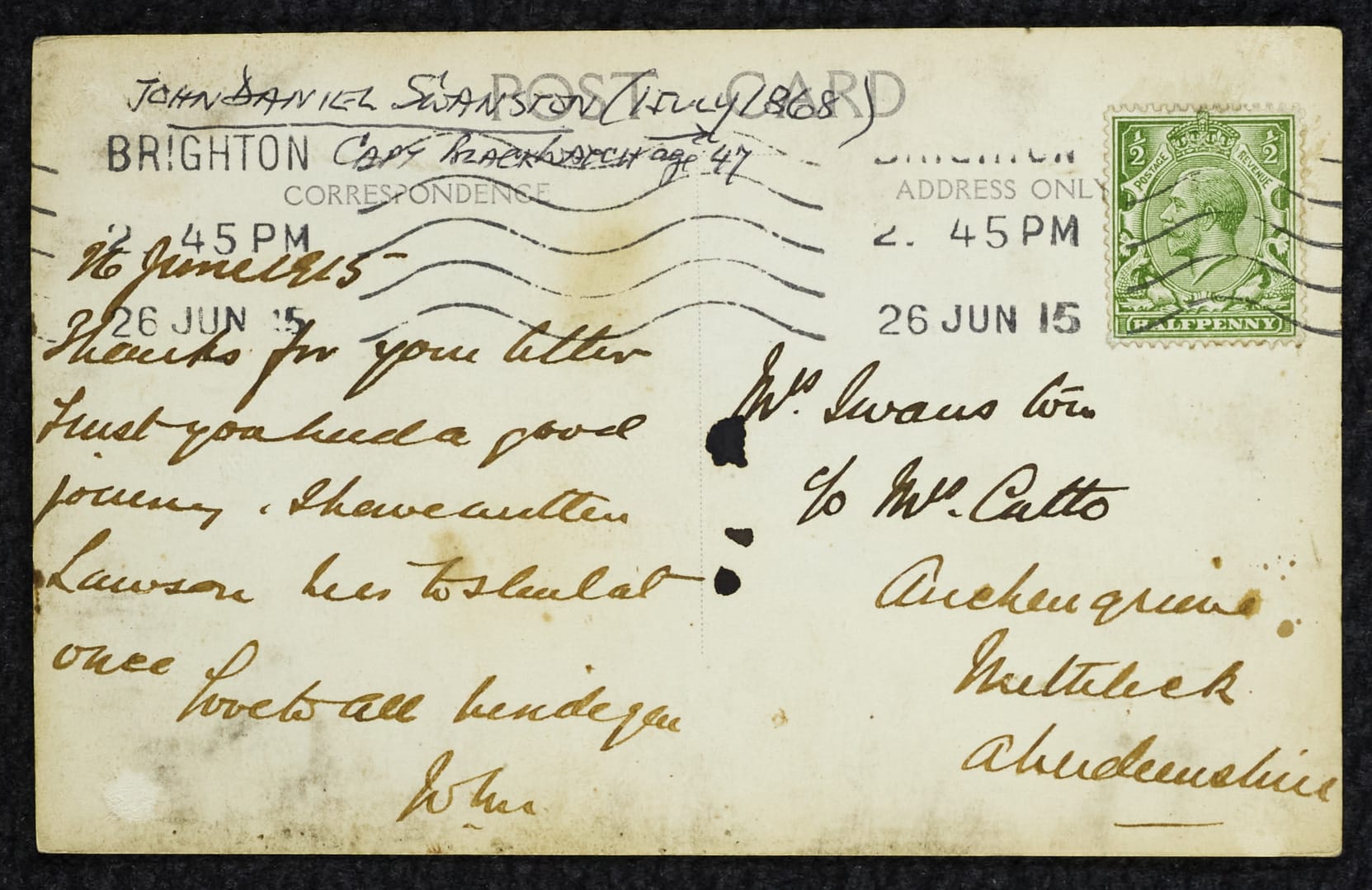
When Mike Hume reached around the back of the crown molding during a routine tour of the King’s in December 2024, he didn’t expect to make history. Mike found a 120-year old message hidden above the stage, when the King’s was originally finished in 1906. We interviewed Mike and his parents, the people that developed his love of theatre.
First up, Mike’s father, Bill, talks about his carpentry skills and how sets were designed and built.
Interviewer
What do you remember about the production, and your role?
Bill Hume
Well, carpentering is necessary, basically. At that time there was a stage director and the stage manager who had ideas about what was possible in practical terms, but the Stage Manager’s sister was married to a a fellow called Max Smart who was an architect but also delighted in producing stage sets for people to build at 3/8 of an inch to a foot, which is a very funny scale when you have to work out and he would produce a complete painted set.
Mike Hume
Set model.
Bill Hume
Up to that scale of what he wanted, to to have reproduced and it was then up to the, the the, the practical folk to get the bits of wood and, and canvas and so on of the right size and shape and then we recruited an artist to put the paint on it and took it to the theatre and put it up and allowed the actors to act around it.
Krys Hume
And I was one of them. I, I was in the chorus of Pirates of Penzance, so I didn’t have much to do.
The People’s Theatre
Mike discusses the differences between the King’s and Festival Theatres and the type of entertainment that made the King’s so popular.
Interviewer
I wanted to go back to the point you made about working class theatres; I think the King’s is this really interesting dichotomy between opulence and also being a place of we’re going to make it work. We’ll fix it no matter what. When you were growing up, how did you characterise the King’s in that context with other theatres in Edinburgh?
Mike Hume
Well I think the King’s was was always the place that had the shows that ah the the the middle class families wanted to see. It wasn’t the opera, and it wasn’t gigs at the Playhouse, and the Playhouse was was alternating between films and live gigs at the, at the time. And, you know, smatterings of more classical movies like Fantasia, I think we want once went to see and um, you know there, there are families who have interest in Ballet and Scotland is lucky to have so many amazing companies like Scottish Ballet and Scottish Opera. But let’s hope they they continue to receive funding to do the amazing work that they do but, when you’re bringing up a family and there are all the expenses associated with that, you have to go and see live theatre that suits the whole family and more often than not, you would find that the productions that you want to see eh are are at the theatre that becomes the theatre of the working class and and and this is not unique to Edinburgh, it’s it’s across the the country. There are direct comparisons with Glasgow and theatres like the King’s in Glasgow and the Theatre Royal in Glasgow and the Theatre Royal is an amazing venue designed by Charles Phipps and is the best example of his, his architecture that that that still exists, but the people it’s not the people’s theatre. The people’s theatre is the is the King’s in Glasgow because that’s where they saw pantomime and where they saw the shows that resonate with them. And the King’s in Edinburgh is is, you know, cut from the same cloth. Where I I really think that that the the pantomimes being there make it the venue that people are most familiar with, where they see the the shows.
Mike, Bill and Krys Hume Oral History Transcript
Mike Hume
…Of the theatre or the actual the, the rear of the proscenium arch.
Bill Hume
So if you go into that old company office, which became a dressing room, that was on the other side of the wall from from above the Stage Doorkeeper’s office. And when we were in there previously, they showed some of the original ceiling colour that was a dark greenish, khaki brownish colour and the side above the artist’s entrance to the stage where it is now, not the original door, um there is that strange sort of door that is that went into the dimmer, what would be what was the dimmer room and that the the the switchboard was originally, as, as I understand it, on the side wall of the theatre…
Mike Hume
Right. Could have been.
Bill Hume
… with all the gubbins going back into that space and and as, as John thought he discovered that the painting of that wall matched it being a dark sort of backstage colour.
Mike Hume
Uhm, uhm.
Bill Hume
So I and there are a lot of theatres where it is on the back wall of the proscenium, but it looks like at the King’s it was just round the corner…
Mike Hume
That that’s possible…
Bill Hume
… upstage, downstage.
Mike Hume
… because you could see above the above the Stage Manager’s position where a bit had been cut away…
Bill Hume
Yes.
Mike Hume
There was only a there was a ladder up and only comparatively small, you know, a foot or so depth left, you couldn’t have actually have stood and worked on that platform, but it could have come out before the ladder was there, yeah.
Bill Hume
Yeah.
1.46
Interviewer
What you’ve been listening to is an oral history with Mike, Bill and Krys Hume as part of the People’s Archive for the King’s Theatre Heritage Project. Today is the 30th of July 2024, and we’re going to pick up the interview now. Can I ask you all to please state your full name?
Mike Hume
I’m Mike Hume.
Krys Hume
I’m Krys.
Bill Hume
And William John Moffat Hume.
Krys Hume
Commonly called Bill!
Bill Hume
Yes. [laughs]
Interviewer
And can you each ah tell me your date of birth?
Mike Hume
Sure, 23rd April 1976.
Krys Hume
2nd of October 1943.
Bill Hume
8th of November 1942.
Interviewer
Can you please tell me how you were all related?
Mike Hume
Ah so I am Krys and Bill’s son, the younger of two children.
Krys Hume
And Bill is my husband, and Mike is my younger son.
Bill Hume
Yeah. We got married in 1965.
Krys Hume
Yes.
Interviewer
Can you tell me about your childhood and where you were born and raised.
Mike Hume
Yes, born raised in Currie just outside Edinburgh and I went to school locally in, in Currie and got interested in theatre by my Dad’s involvement in the Edinburgh Gilbert and Sullivan society and I’ll let him say more about that.
Bill Hume
Yes, as as a result of eh basically wider family involvement in the Gilbert and Sullivan society, I got involved in the practical end of eh staging eh the the annual production of the Gilbert and Sullivan. I used to have a week in the King’s Theatre latterly; previous to that they’d had the Gateway Theatre, which was quite a small one in eh Leith Walk at Edinburgh and then we moved for a time to Leith Theatre, which was a marginally acceptable venue before we could actually justify the move into the King’s and taking a week with other amateur companies also having their own week in a spring season.
Mike Hume
And when was the first show in the King’s of the…?
Bill Hume
First show in the King’s was 1973.
Interviewer
What performance was it?
Bill Humes eh
Pirate. Pirates of Penzance, I think, [laughs] now you see I’ve not got my cheat sheet with me, which I gave to, [laughs] to Jordan.
Interviewer
You can always compare.
Bill Hume
Yeah, but it it’s it’s, I’m pretty sure it was Pirates of Penzance, yeah.
4.52
Interviewer
What do you remember about the production, and your role?
Bill Hume
Well, carpentering is necessary, basically. At that time there was a stage director and the stage manager who had ideas about what was possible in practical terms, but the Stage Manager’s sister was married to a a fellow called Max Smart who was an architect but also delighted in producing stage sets for people to build at 3/8 of an inch to a foot, which is a very funny scale when you have to work out and he would produce a complete painted set.
Mike Hume
Set model.
Bill Hume
Up to that scale of what he wanted, to to have reproduced and it was then up to the, the the, the practical folk to get the bits of wood and, and canvas and so on of the right size and shape and then we recruited an artist to put the paint on it and took it to the theatre and put it up and allowed the actors to act around it.
Krys Hume
And I was one of them. I, I was in the chorus of Pirates of Penzance, so I didn’t have much to do.
6.29
Interviewer
So what got you both interested in theatre in the first place?
Krys Hume
What was Bill’s uncle, Bill’s Uncle John? John Miller, who was eh Was he president of society?
Bill Hume
President.
Krys Hume
So after we were married in 1965…
Bill Hume
Post University.
Krys Hume
… we kind of got, got into the Gilbert and Sullivan society and we took it from there and Bill was in it for many years. I was in the chorus for a number of years until I had my first son. So I, I would be in it in 1973, but not in ‘74. And then I was in it again in 1975. Before I had Mike, but I found that having a child a one year old and being in the theatre five or six nights a week was not really compatible. So that was my last year. [laughs]
07.21
Interviewer
What is the prep for a week long show? How intense are the, eh the rehearsals?
Krys Hume
Well, the rehearsals, the way the G and S ran it was the first few rehearsals were music rehearsals. We just sat in rows eh with your music and you learned it all off and you sang it all. Chorus bits and the, the soloists did their bits and then you gradually progressed to being without, you were, you were given a date by which you had to be without books, and you had to know it all off by heart. And then we moved to a place, a big enough place where you could actually start moving about and the director would tell us what to do, where to go, and so on. The soloists had separate rehearsals as well, of course, and it wasn’t just the soloists and ourselves, they had separate rehearsals, and then we all put it together and gradually over a few months that came together, so we would start in about September, October for a production in Marching or April.
Interviewer
And how long was the process for set design? From start to finish.
8.38
Bill Hume
Well, usually by the spring of the year eh the the Council of the, the Gilbert and Sullivan Society, had decided what show they wanted to put on. Gilbert and Sullivan have basically 12 collaborations and they get chosen in rotation. Some of them are not as good as the others. Some of them are particularly popular, and you can always guarantee a good house. If people wanted to see it, even although they’ve seen it before, others are a bit quaint and rather difficult to do. Or something like that. And take a bit more time. So in the spring, eh having decided what show they want to put on the next year, they would then start organising auditions and talking about, say, the the ,Max, for example, designing a set and working out what was involved, usually along with the producer, as we called the director in those days. I, the the, producers learning what was possible.
When you have a space like the King’s Theatre eh you might think that having something like 40 feet square was ample room for anything and on occasion that I’ve been asked, “can we move anything?” when the sets actually in position, “can we have a little more space?” and you’re limited to maybe 5 or 6 inches because there are so many other things that are co-located; the lighting, the scenery, the drapes around the stage, and so on are all organised to what you planned to do, and you can’t really change it.
And in the orig, original set up at the theatre, there was something like 53 separate bars across the stage from which you can hang cloths or scenery and we used to start off with a cloth on bar 52 and behind it a black cloth to help disguise somebody moving behind it, a ripple of somebody going across the back of the stage did not then appear on the backcloth. And that was as far as you could go because there wasn’t any bars beyond that and we built the set and designed the set to use that space.
Krys Hume
That’s…, sorry.
Mike Hume
And I think an important thing about what you brought to the equation that that I could see from the outside um was if you had a plan view of the theatre you would draw a triangle [laugh] over the floor and the key about that triangle was that was the area that everybody could see on the stage.
Bill Hume
Yeah.
Mike Hume
So if, if anything key in the action was happening, it had to be in that triangle or the people at the sides of the, of, of the seats, and we’re not talking about the boxes, but the, you know, the sides of the, the, the, the circles. They would not see something that’s happening up in the back corner. And I would see this from other productions that would bring shows into the King’s where there would be bits of action happen outside that triangle and um your understanding of the space… You were always telling the director, you know, there was always this triangle that if anything’s gonna happen, you you can make it happen outside the triangle but people are not gonna see it and and …
Bill Hume
It’s the the the baseline is between the sides of the proscenium arch and in the King’s with with the the arrangement they had was more or less the same distance upstage of 30 feet, and that narrowed and people at 30 feet upstage could just be seen by folk all around the house, provided they were at stage level. If they were at all above stage level, the head disappeared when seen from the uppermost seats. And so if you if you had a construction as we usually did where some parts of the set were raised relative to others, they had to be either far enough downstage that the person can still be seen. They have to be far enough in to be on on, at least on the edge of this triangle. And they also, therefore, after they leave enough room for a decent sized chorus because certainly Gilbert and Sullivan, yes, there are principal characters who act it out, but without a doubt, the action of the chorus in reinforcing things and reacting and so on Is a particularly important part of what people like to see, especially if they know the people in the chorus. [laughs]
Mike Hume
Especially yes, especially for amateur theatre where you come to see Davy on the stage Davy or Dorothy and, and if they’re off at the side because they’re in the chorus, then you might not come back the next year. So it’s, it’s very important for community or amateur shows.
Krys Hume
I still remember the time and this is nothing to do with G&S, when you and I went to see A Midsummer Night’s Dream and we were in the back seat, the back row of the gods of the upper circle, and it seemed as if the action was miles away. And of course you put what you saw was quite limited. We didn’t ever sit in these seats again!
14.47
Bill Hume
A A broader part of that story, what happened was you had been in the morning…
Mike Hume
I had been with the school.
Bill Hume
The schools production and had been sitting down relatively lower seeing further upstage. Was there something with bicycles involved or something like that?
Mike Hume
It was a very quirky set that had a lot happening and I was so taken with the production that that I wanted you to see it and then we went back, but it was sold out apart from the last few seats at the very back of the upper circle.
Bill Hume
Immediately under the follow spots, they were the only set of four seats still available.
Transcript Part 2
Michael Hume
As I describe, the, you know the, the original design of the theatre was a, was a four tier house.
Bill Hume
Yeah.
Michael Hume
And ah what was done in the 1950s was the top level um I think it was called the Gallery, it was always uncomfortable, but latterly unsafe is the way I’d describe it you know, it was all bench seats and um Peanut gallery I guess you’d, you’d call it in in America and so the thinking was that they would keep the, the front of the middle circle and they join it with the rear of the original Gallery, and that’s what resulted in a very steep what we now, what we call the Upper Circle which is a ridiculous amount of seating which would never have been designed in that way, and that also explains why there are large swathes of plain plaster wall on either side of the auditorium, which of course is not how you would design it if it was going to be that big of an open space, but in the 1950s you have this intervention of removing the top Gallery and then creating one massive middle gallery that then went up to the rear and, you know, there’s always limits from money on projects and you don’t end up putting any decoration on the walls and that’s why we ended up with the plain walls and, with the renovation project, that will be largely corrected because that level will be, that, that top Upper Circle will be of a much more proportionate size.
Interviewer
Now it’s clear you have quite a lot of knowledge about the architecture of the King’s Theatre and ah recognition for how special this Edwardian building is. Can you tell me a little bit about your personal connection, to the King’s?
Mike Hume
So when I was very young, I remember, I saw these fantastic models that Max Smart had made and, and I can picture right now the model for The Sorcerer that he made, which was , it wasn’t just a, a model of the set. It was the fact that he had the ability to paint it as a, as an artist to, to really let you see what the set was going to be like and to me they were like very delicate toys and I would enjoy looking at the angles you’d see from the audience, but then looking from above ah to see what that translated to, to understand the physicality of what was behind it and and, you know fascinated me, that you had a a podium as part of the set which looked like stone from the front, but when you went round the back it didn’t have the other two sides cause they’re not necessary, you know, it’s, it’s like movie sets. That all that you see, it’s like Hollywood it’s just a facade that you only see what you need to see and the bits off to the side are just temporary. And if you look at it from the back, it’s not finished. And that fascinated me, to want to understand more about the magic that went on behind the curtain. And so when I was very young eh and Bill was, you know, the theatre all day putting up the set that he’d spent months building with his colleagues um Krys would take myself and my brother along and you know, the first year we’d get to, we’d get to see what was going on for an hour and then maybe the next year we were allowed to be there for a couple of hours and it became a fascination to, to understand how all this magic happened and the other part of it was that Bill’s relationship with the staff at the King’s Theatre meant that when we went to the annual pantomime and and no doubt I was an over demanding child. Eh I don’t know, the the end of the story is that we got to go backstage and see the magic from backstage and that included things like seeing Stanley Baxter’s frock that was a, a chandelier hanging up or even getting to catch a glimpse of Walter Carr or eh Una MacLean or Stanley Baxter. I don’t think we ever got to, to meet them, but, I don’t know whether that was something that you were happy to do or whether the petulant child in me wanted to do it so much that you made it happen, but that was a highlight of seeing professional shows that were em touring the circuit of I think it was 4 local corporation theatres at the time. They started off in Edinburgh because the the sets were, the costumes and the sets were made in Edinburgh, um at the sets were built at the , it was an old library not far away from where we are at the Festival Theatre right now,
Bill Hume
The Nelson Hall
Mike Hume
The Nelson Hall, yes.
Bill Hume
At the Pleasance.
Mike Hume
And then these. These productions went to the Glasgow King’s, the Sunderland Empire and was at the Newcastle Theatre Royal?
Bill Hume
Possibly there were certainly Glasgow and Sutherland. I don’t remember the fourth.
Mike Hume
Yeah, because it was. It was three theatres to start off with and it became four and and and basically that was a Howard and Wyndham essentially circuit. And to get back to my point, um seeing Aladdin and Aladdin’s lamp and the pyrotechnics and folk coming up through the old star trap that that used to be there, seeing all that from the front and then knowing that afterwards we’d get to go backstage and see everything from behind was just a fascinating combination for for me and and and I loved doing that every year and we come full circle that now now that I am eh middle-aged I take Bill and Krys to the pantomime every year because I and and and I now live abroad, but always come back for the the holidays and remember that my parents used to take me to the pantomime and now I take them to the pantomime because it’s a it’s a great tradition to carry on and pantomime is of course, a uniquely British phenomenon. And it’s the way that most. Eh people first experience theatre.
Bill Hume
Yeah, yeah.
Mike Hume
And yeah, it is a, you know, in America where I live, a lot of people’s introduction to theatre is again around the holidays at Christmas time, but it’s going to see perhaps a a Christmas concert or a production of The Nutcracker that that somebody’s ballet school is producing. But the uniquely British phenomen… phenomenon of pantomime means that you’re seeing, by definition, a spectacular variety hall show extravaganza that I defy anybody to leave from without a smile on their face unless they dropped their ice cream at the interval! Um and that introduction starts a bond with the theatre that you experience those things in and if you look up and down the country, the special relationship that people have with the, their favourite theatre in their hometown, where there’s multiple theatres, it’s generally the theatre that is the home of the working class production because the the concert halls and the royal theatres and so on they don’t have pantomime each year and I strongly believe that people’s bonds with theatres and their love of a particular theatre comes out of going to the theatres as a child and experiencing pantomime in that old British hall, British Music Hall variety type production and that sets up an affinity that people have for their relationship with their sort of favourite theatre in their hometown, which is just interesting to think about because it’s not something that happens in other countries.
Krys Hume
But not only do you take us to the pantomime, but like we did for you, [laughter] you take us backstage after the pantomime and it’s it’s fascinating to see how some of the magic, apparently magic things were performed. I mean that time they had the horse, they they flew in the coach. And it was incredible to see backstage how it had all been done. So that that adds very much to the enjoyment of pantomime.
Mike Hume
And I think that, you know, the people talking for a moment about the people that work backstage in theatre, they are magicians they’re wizards and wizard wizardesses, and I remember Ian Gillespie, the resident Stage Manager at the The King’s Theatre for many, many years who was known affectionately by everybody as Puggy, and there was no, there was no requirement that he could not meet. You could not throw an ah problem at him that you thought was a new problem. He’d always had another problem to solve for somebody else’s show that he could solve your problem and there isn’t apprenticeships per se in theatre, but absolutely the model of having people like that in charge and sharing their knowledge and wisdom that’s been granted to them by their previous seniors is an amazing thing about British theatre. And you know, with the COVID-19 pandemic, we lost a lot of skills from… by people having to move into other industries, and I think that has created a a challenge now where eh that chain was broken for a while, and not everybody has come back into the, the industry and a lot of what is done in technical theatre is problem solving that is done by the knowledge of how did we, how did we solve this before? Ah and it’s inter… going to be interesting to see how those challenges are met in new ways going forward.
Bill Hume
Even, even if it’s a simple thing, like a dropped curtain, I, I remember one time we were doing The Mikado and the archway at the back had a piece of cloth across it, simply that you couldn’t see who might be standing behind it. And then you pull on one string and the croth [sic] drops immediately clear to reveal the person behind it. And I’ve done that also on rather larger stages, not a, not a huge one like the King’s, but at other places we’ve arranged the drop curtain and it’s a purely mechanical thing that when you pull this piece of string, all the fastenings come loose at once and the curtain has no alternative but to drop. But still the audience see what they think is magic as they don’t know how it’s done. And there are things like that which are very simple. For example, in eh Ruddigore eh the story of the Ruddigore opera is that the Lord of Ruddigore of the time has a picture gallery full of his ancestors who all come to life in the middle of the night and tell them to do things and basically, as they were wicked, they want him to be wicked too. OK. How do you make a set of portraits come to life? We’ve done it two ways. One is that eh the pictures are painted and gauze and then the lighting’s changed and the the lighting in the box behind the person lights up, to show the person in the box and that the gauze is then lifted up out of the way and the person steps out of the frame. The alternative was to have two doors, one with a picture on it, with the person on it and the other door has a picture, but without the person and all you do is open one door and close the other so that you suddenly change the picture, but you have to distract the audience while you’re doing it. When you do it with lighting effects and possibly noise as well. And the thing that until you are aware of it, you don’t realise how effective it is. We had a problem one time with a a a trick wire across the stage which came loose and we need to have a chair, it was Ruddigore again, to move without anybody near it. And this wire had become detached. So at the transformation when the the the the portraits were coming, one of the stage crew just simply ran across the stage and recreated the wire across the stage and nobody, including the Musical Director who was possibly no more than 10 feet away, noticed this chap run across the stage because the misdirection with the light and so on was so complete that what was actually happening on stage was simply not seen by the audience and they did not realise that they did not see it.
Transcript Part Three
Interviewer
I think you’ve brought up a really interesting point, which is; when mistakes are, you know, what we would classify as a mistake in a show…
Bill Hume
Yeah.
Interviewer
… being part of a show when you see some of those pieces, that’s still an element of magic because you feel like you’re getting to be behind the curtain and you don’t know what you’re expecting. So it’s still, it kind of integrates into the performance.
Bill Hume
[laughs] There was one time when somebody coming from the back stage pulled over a pillar, which had a weight in it, but it wasn’t otherwise secured, and their cloak caught in this and the pillar fell down. And my sister happened to be in the audience and noticed this happen and said “I wonder how it will go back to normal” and the next time the chorus came on stage, the last person, two people in the chorus straightened up this pillar very quickly.[laughs] My sister realised that exactly as she had predicted, it got sorted on the day by me picking the folk who were last on and saying “put that pillar up as best as you can. Give it a try and see what…”
Mike Hume
I think going back to the idea of stage spectacle and, and creating illusion, um there’s very few that, there are very few things even in today’s world ah where there is a new solution. Things have, so even shows like Harry Potter and Stranger Things, which are both playing as, as we speak at the moment in London, ah for sure, Harry Potter has some magical effects that are a, a mixture of magician type, stage illusion and old stage effects, and I’m not trying to say that the amazing effects in that show are not original because there have been some, the magician that worked on that did some amazing effects, but you know, whether it’s dropping a body from the heavens or it’s doing a big reveal, or as, a,s as Bill was saying, misdirection, so that you can change something and then reveal it to the audience, all these tricks are done in, tried and tested ways and it’s pretty difficult to think of examples where you really are inventing something new. And often these tried and, you know, if you go and see both those shows I mentioned, Harry Potter and Stranger Things, you will, there are perfect examples there of misdirection so that they can reveal something to you that you didn’t see changing. Or em combinations of lighting, sound and now video effects being integrated together so that you can shock and you get that sense of shock and awe from, from an audience. But there are, it it it’s rare to go and see a show, when you’ve worked in technical theatre for many years, it’s rare to go and see a show and to not know how a certain trick was pulled off because there are just certain ways that, that you do things and and it’s it again it’s passed on. It’s passed down through generations of how, how you make the magic happen.
Bill Hume
Yeah.
Interviewer
I wanted to go back to the point you made about working class theatres; I think the King’s is this really interesting dichotomy between opulence and also being a place of we’re going to make it work. We’ll fix it no matter what. When you were growing up, how did you characterise the King’s in that context with other theatres in Edinburgh?
Mike Hume
Well I think the King’s was was always the place that had the shows that ah the the the middle class families wanted to see. It wasn’t the opera, and it wasn’t gigs at the Playhouse, and the Playhouse was was alternating between films and live gigs at the, at the time. And, you know, smatterings of more classical movies like Fantasia, I think we want once went to see and um, you know there, there are families who have interest in Ballet and Scotland is lucky to have so many amazing companies like Scottish Ballet and Scottish Opera. But let’s hope they they continue to receive funding to do the amazing work that they do but, when you’re bringing up a family and there are all the expenses associated with that, you have to go and see live theatre that suits the whole family and more often than not, you would find that the productions that you want to see eh are are at the theatre that becomes the theatre of the working class and and and this is not unique to Edinburgh, it’s it’s across the the country. There are direct comparisons with Glasgow and theatres like the King’s in Glasgow and the Theatre Royal in Glasgow and the Theatre Royal is an amazing venue designed by Charles Phipps and is the best example of his, his architecture that that that still exists, but the people it’s not the people’s theatre. The people’s theatre is the is the King’s in Glasgow because that’s where they saw pantomime and where they saw the shows that resonate with them. And the King’s in Edinburgh is is, you know, cut from the same cloth. Where I I really think that that the the pantomimes being there make it the venue that people are most familiar with, where they see the the shows.
5.57
And you know the the idea of what what the arc, the interior architecture, if you look at the King’s Theatre, eh it was designed by two people, eh John D Swanston, and I forget the second guy’s name, but essentially it was it was an interior and an exterior architect and the exterior guy ah was from the West Coast of Scotland and if you look at architectural descriptions of the King’s Theatre, you’ll see the the King’s in Edinburgh being described as Municipal Glasgow architecture. It looks more like a bank than a, than a theatre, and of course it’s very rare in an Edinburgh building to be of that red sandstone colour which is much more common for for Glasgow. But the interior architect, who hadn’t done that many theatres, ah really found a, an exquisite style that we call it Viennese Baroque. And the the opulence of the, you know, trumpet playing putti, the cartouches and the piece that everybody is familiar with, the the caryatids who are muses of theatre with their masks and their musical instruments and their bared bosoms, some of them which would be shocking to to think of as an interior of a theatre now, but this exquisite Viennese Baroque in creams and golds and light beiges ah is just exquisite to to the eye and and I’m sure that I am not alone that your your first visit to the theatre as a child, you’re overwhelmed by the opulence of this interior. And, you know, part of that intent was you you went to this place that was wondrous. And even if you had only a couple of shillings to sit upstairs you were still somewhat immersed in this glorious building, you know. Like any theatre, the, the, the, the fanciness retreated the further up you got, which meant, which was equivalent to the the the less you were paying, because that’s the way that the the class system worked b that’s one of the amazing things about what’s being done with the King’s redevelopment right now is to, is to be able to open up the whole theatre to everybody, no matter what anybody is is paying um and it is not the way of not the thinking from 120 years ago. But it’s fantastic that it that it now is, So but everybody, everybody can experience that that opulence, which, ah you know, there’s not many places that you go to that are like that to experience something. And I think that that that goes for all theatres. You know, I think that’s why we build, why we built theatres in an opulent, opulent, impressive way and and in America, there were film exhibitors Marcus Loew built theatres. He had the, he famously said “I don’t sell tickets for movies, I sell tickets to theatres.” and the opulence was intended so that anybody could come and feel like a king or queen for three hours. They would pay their their, their 50 cents, and for three hours they would be waited on by staff, ah served refreshments in fanciful settings and then see a production of some sort or a movie in the US ah in an auditorium of was it design and that was an intent of why we made theatres beautiful, unique spaces. Ah and it’s great to see them being preserved 120 years later.
09.58
Interviewer
So what are the elements of the King’s that you hope to see when it reopens, and what do you hope is different?
Mike Hume
I think, the biggest key thing is the activation of a unique space for more than just three hours in an evening. And by opening up the building to, you know, if you wanna, if you wanna meet somebody for a coffee, you’ll be able to do it at the King’s. If you want to have a community meeting or to rehearse your new Fringe play, you can do it at the King’s. If if you have a school where you want to show, eh schoolchildren how things are done, whether it’s how the ballet dancers dance or how it’s how the lights work backstage, there will be facilities where all that can be done in in spaces that are, it’s designed for. You know it’s not, having a school party on a stage is not the smartest thing because there’s lots of things that move and drop and happen without much notice, and there will be spaces where all that can be done in the safe environment. And there will then be the story of the King’s, the people’s theatre in Edinburgh, which will be accessible, not just to people who are paying to buy tickets, and that’s very important. People who will be able to come off the street and even just spending time in the Box Office, they will be able to read about the history of the the theatre and also making that available online by collaborating with archives, with the libraries will open that up, will open up the the story of the King’s to, to more people. So it it really is about how the building and what goes on in the building can be made more accessible to everybody in a fair and non exclusive way and to be available for more time than, you know, theatres were traditionally, 30 years ago they were only open for three hours in in the evening and to be able to pay their way now you need to have a building that’s activated with more [child noises in background] than just that, or you you you can’t compete with today’s costs.
Interviewer
There was such a public outcry to save the King’s, and usually at this point in the interview I ask [child noises continue] you know why you think it kept that hold on people, but I think you’ve actually really eloquently answered that.
Mike Hume
Well, a theatre [clears throat] it’s important to say that a theatre is not just the fabric of the building and the gilded plasterwork and the, the, the, the big red curtain that goes up, it is the feelings that it instils in people and the memories that it makes and those delights of Stanley Baxter walking onto stage dressed as a chandelier which gets a laugh and then he flicks the switch and the lights on his head, on his hat come on and it’s that that tips the audience over, over the edge. So a building in of itself can be as opulent as you like but that doesn’t make it the place that people want to be; it, it becomes special only because of the memories that people have and that they form by the the shows that they see and the people that they meet at those theatres and that for the people’s theatre of of Edinburgh in the King’s Theatre, is why it is so important to everybody that has been and seen, whether it’s one show or the pantomime every year ah because it’s built into the DNA of the people of Edinburgh. And to think that that facility might not exist just became so unacceptable to the citizens of Edinburgh that people people pulled out their their wallets to make sure that the Grand Old Lady of Leven Street would be there for another 100 years, which is an exciting thing to think about. So I think one of the most important things that that eh I tell people about historic, these amazing historic theatres that mean so much to us is that historic theatres are like dogs… Everybody’s favourite historic theatre is the best theatre in the world and everybody is right. It’s the memories that are formed that make the place so special. And it’s just like your dog being the best dog in the world… And everybody’s right.
Interviewer
That’s a really beautiful sentiment. Um I want to say thank you so much. Ah as you said, it is the People’s Theatre because of people’s stories and you’ve become and have been part of the story. I’m just glad we’re now able to share it in a different way. So I wanna thank you both. All three of you. [laughs]
Krys Hume
Well, I didn’t contribute much, but they’ve been much more involved than I have. But Max Smart, who did all the designing, he was also leading tenor in the society he used to sing regularly…
Bill Hume
He used to sing principal roles.
Krys Hume
… sang leading roles. Yes. He wasn’t just a, the stage designer and so on.
Interviewer
Jack of all trades.
Krys Hume
Yeah, and his wife was everything all the so.
Interviewer
Master of actually several. [Laughs]
Bill Hume
Sadly he’s no longer with us, nor is his wife, Jinty.
Krys Hume
Jinty
Bill Hume
Janet Smart. OK.
Interviewer
Well, this last question is going to seem a little bit silly but. Are you going to return to the King’s when she reopens to see the panto?
Mike Hume
I would say that’s highly likely, yes. [laughter]
Krys Hume
I would say so too, yes.
Interviewer
Well, thank you all so much at this time, I’m going to conclude our interview for the People’s archive.
Transcript Part Four
Bill Hume
…like the ones that are around the Houses of Parliament, there’s a quite distinctive top to each of the stone pillars. And he’d taken the trouble to create the this special talk on two pillars. And then we had stretches of railing which ran off into the wings. And this gateway was part of the, quite an important part of the set of this particular performance of Iolanthe. But what we didn’t know was how we should attach the railings onto the pillars. And Ian Gillespie…
Krys Hume
Ian Gillespie solved it, did he?
Bill Hume
…he basically looked at it, said what we do is we cut here and put this bit through here and then a, a, a screw or a pin can go in there and that’ll hold it perfectly well… And it did.
Mike Hume
Yeah. Always knew how to solve a problem.
Bill Hume
Yeah.
ENDS
Jane Gillespie
My Mum the Variety Star
Before Jane came along, her mother, Mary Rose, was a talented dancer in the Half-Past Eight Variety Show at the King’s and other theatres. Hear Jane talk about what she learned about her mother from the materials now held in our archive.
Jane Gillespie
Yes, my Dad, when they were, I don’t know if they were ever engaged, well they were, I’ve got her ring on [chuckles], they were engaged, he used to go and see her in the King’s and he said he could always pick out my mother, when all the girls were standing waiting to come out, he could always see her heart beating because she was nervous, poor thing, that was quite, you know one of the few romantic things he ever said about her… these costumes….
Interviewer
Do you, are these, would she, do like these ballet productions as part of the variety shows do you think?
Jane Gillespie
I think so, yeah, yeah. It was, I know with the, the Half Past Eight Company that she did tour with them, certainly she used to talk about going to Aberdeen, and Glasgow, to Dundee. I think it was just round about Scotland, but em yeah…
Interviewer
Did finding these photos change anything about the way you understood your Mum?
Jane Gillespie
You know it did because it was more, well these ones, to see her in some of these costumes, and you just think oh goodness, but also all the photographs she’s got from so many men who were stars at that time, you know, taking part in all these shows, and a lot of it quite personal, little notes and things, there’s even one about her biting her nails, “You’ll have to stop biting your nails, Mary Rose”, things just little and I’ve got little cards at home as well all little personal things, so one thing surprised me, I think she had quite a lot of male friends, so that was [chuckles] I think she was admired quite a bit. [Pause] She wasn’t engaged then, by the way! [Pause] And I think it’s from, too the photographs, she was very popular, and that’s the thing that came across. Em people liked her.
Interviewer
I mean, we have some lovely pictures as well with her, just…
Jane Gillespie
Yeah, yeah.
Interviewer
… the rest of her dance troupe maybe, which is really, just. As you know, it’s just a lovely thing to see.
Jane Gillespie OH Transcript
Interviewer
This recording is for the People’s Archive as part of the King’s Theatre Heritage Project. The date is the 13th of June 2025 and I’m going to sit down and speak with Jane Gillespie today. The time is 2.43pm and we will begin the interview now. Please can you state your full name and date of birth?
Jane Gillespie
My name is Jane Rose Gillespie. My date of birth is 22.5.[19]57.
Interviewer
Can you tell me a bit about where you were born and raised?
Jane Gillespie
I was born in Edinburgh. Em lived here for the first five years of my life and we moved down to the Borders with my Mum and Dad lived down there for, my sister, two, three years, then came back up to Edinburgh. My Mum missed it so much, it was her, her city and her mother was here too, so it fitted in with all the childcare and everything like that. So we’re back in Edinburgh and I’ve more or less been here ever since. My sister, she moved to Denmark, so I went to Copenhagen a few years, eh worked over there, lived in Glasgow, lived in Fife but I always come back to Edinburgh. Love it.
Interviewer
And you mentioned your parents, what profession were they in when you were growing up here?
Jane Gillespie
The reason I’m stalling is because it’s quite a, my Dad, he went to Nautical College, [clears throat] excuse me, but suffered quite a few ill health problems so he had to leave. And then my earliest memory was when we went down to the Borders, he worked for Hoover, Hoover Company, em as a service repairman. So he drove all around the Borders repairing people’s vacuum cleaners and washing machines and he didn’t enjoy it. You know he was a very bright man and but that was the way things like that happened in life then. And we came back to Edinburgh, my Mum ended up working in the Co-op [chuckles]. She managed the wine and spirits counter. So she was, she was happy enough there but again they were two very clever people so we’re never quite satisfied with the way things happened and ended up in a Council, not ended up, I was very happy living in a Council house in Grierson Crescent in Edinburgh.
0:02:18
Interviewer
Do you have any particular memories of going to the theatre as a kid?
Jane Gillespie
Well my father ended up working in what was Bruce Peebles, so every Christmas we’d end up in the King’s to see the Panto. So that was from the age of eight onwards and that was, that’s what happened every year. I loved it, absolutely loved it.
Interviewer
Do you remember any particular productions?
Jane Gillespie
I actually don’t. I’ve got, I more remember what I was wearing, a red velvet dress with white lace around the bottom [chuckles] very fancy.
Interviewer
Can you tell me a bit about this collection that you’ve donated to the King’s Archive?
0:03:01
Jane Gillespie
Yes, it was, it was in our house for a long, long time. And then my Mum died when she was 65 and had a bit of a clear out and I took things that were sort of important to her. And I found this, it was a red felt sort of folder that she’d made at school. It was all embroidered and all this, that was all inside it. And it was special to her. It was a very special time but it’s been lying in my basement ever since and I’m having a clear out and I just thought I need to do something with this that she would appreciate and she would love and you know it’s also about the King’s, it’s about her life at that time. So I just thought, better being with you than ending up in a bin somewhere.
Interviewer
How would you characterize her if you were…?
Jane Gillespie
She was very funny, very clever, very funny, chatty, very sociable and a lot of these things she didn’t actually get to show or demonstrate in her life. I think just because of where she ended up working, she could have been doing a lot, lot more and I think that’s just, you know, not long after the war and everything and I don’t know the exact year they got married but I looked at her contracts with the King’s, it wasn’t long after that I think she got married and then when you got married that was you. You didn’t work, didn’t do anything. She was a, she was a wife. And I think that stifled her personality a little bit. But no, she was, she was lovely.
0:04:35
Interviewer
Do you know anything about any of these images? We love this one, which is a picture of her that’s been coloured in.
Jane Gillespie
Yeah.
Interviewer
Is that, do you know anything about that?
Jane Gillespie
I’m really sorry but I don’t, but that was a thing of that time and a lot of her other photographs, em of relatives of mine as well, that was a thing they did then was to have the black and white and it was, I don’t know how they did it, but it was just hand painted watercolours. I have quite a few and have some with her but she’s always got the big red lips, so the eyelashes,[chuckles] little things highlighted, which is really nice. But even that particular one, I don’t know what it was. I’m sorry to say, because I loved her. I think at the time when she was perhaps showing me things, when I was maybe at primary school, I thought, well, that’s nice, that’s nice, but you didn’t get the full story behind it. And every now and again she would give things out. But I left home when I was 18 and didn’t really have that much going back over all the sort of history and everything. But I wish she had, because I mean you may well ask, but I don’t even know how she came into, into the dancing career. But she certainly could dance. I did ask her once to teach me how to tap dance, but we lived on a top floor, it was four and a block, she said she couldn’t because the old lady downstairs wouldn’t like it. I wish she had. It was, yeah.
Interviewer
Yeah that would have been lovely.
Jane Gillespie
Uhmm.
Interviewer
That’s really nice that she spoke about it though.
Jane Gillespie
Yes, my Dad, when they were, I don’t know if they were ever engaged, well they were, I’ve got her ring on [chuckles], they were engaged, he used to go and see her in the King’s and he said he could always pick out my mother, when all the girls were standing waiting to come out, he could always see her heart beating because she was nervous, poor thing, that was quite, you know one of the few romantic things he ever said about her… these costumes….
Interviewer
Do you, are these, would she, do like these ballet productions as part of the variety shows do you think?
Jane Gillespie
I think so, yeah, yeah. It was, I know with the, the Half Past Eight Company that she did tour with them, certainly she used to talk about going to Aberdeen, and Glasgow, to Dundee. I think it was just round about Scotland, but em yeah…
Interviewer
Did finding these photos change anything about the way you understood your Mum?
Jane Gillespie
You know it did because it was more, well these ones, to see her in some of these costumes, and you just think oh goodness, but also all the photographs she’s got from so many men who were stars at that time, you know, taking part in all these shows, and a lot of it quite personal, little notes and things, there’s even one about her biting her nails, “You’ll have to stop biting your nails, Mary Rose”, things just little and I’ve got little cards at home as well all little personal things, so one thing surprised me, I think she had quite a lot of male friends, so that was [chuckles] I think she was admired quite a bit. [Pause] She wasn’t engaged then, by the way! [Pause] And I think it’s from, too the photographs, she was very popular, and that’s the thing that came across. Em people liked her.
08.15
Interviewer
I mean, we have some lovely pictures as well with her, just…
Jane Gillespie
Yeah, yeah.
Interviewer
… the rest of her dance troupe maybe, which is really, just. As you know, it’s just a lovely thing to see.
Jane Gillespie
Yeah.
Interviewer
I’m also very interested in, we have a picture of her wearing what looks like a uniform…
Jane Gillespie
Uhm, yeah she was a WREN [Women’s Royal Naval Service] uh-huh, uhm.
Interviewer
So was this for a show or was she actually…
Jane Gillespie
No, no, no, she was, she was in the WRNS. I think that was very common at that time for women of her age, they were em they were involved. No that was taken outside, I think that was, she lived at Swanston [South of Edinburgh] so outside the bungalow there, maybe. [Pause] At least that’s what she told me, that may be a complete story! [Chuckles] But no, that’s my understanding. it certainly was not for a, it wasn’t for a show. [Pause]
09.22
Interviewer
Is there anything that you think we can learn from these photographs and the newspaper clippings, the contracts and everything?
Jane Gillespie
I, I , just the whole history, and you know, when I look back at these I don’t think in a sense things have changed that much when you look at the women and the performers, and I like going to theatre, I like going to musicals, and I do think about my Mum when I see them and I think, well one of the things that’s changed is people now get paid for rehearsals, she didn’t back then. But it’s just that whole profession and I think to see it as a profession, and I appreciate that now, where maybe I didn’t, I just thought my Mum danced about on the stage, so, but I don’t know what you would learn other than, the costumes, the design of anything. But also how things have changed, I think some of the pose, well maybe not, some of the posing and sitting in the wee, tiny costumes, and that’s my Mum, a wee bit shocked!
Interviewer
I think it’s a really interesting historical reference to see like how, because some of these shows are very similar to what we may see on stage today, like the ballet and things like that, so it’s really interesting to see how it was viewed back then…
Jane Gillespie
Uhm
Interviewer
… and also the way it was performed…
Jane Gillespie
Uhm, yeah.
Interviewer
… and the costumes they would wear.
Jane Gillespie
Uhm. Yeah. Just went to see “Moulin Rouge” a couple of weeks ago and I was, I was thinking about her. Oh she’d have loved that.
Interviewer
Em, is there anything else you would like to say about her.
Jane Gillespie
No, just I think, I think it’s quite a sad story, that she didn’t, I suppose it’s probably the same now when you get to a certain age, and you can’t pursue that kind of career, musical theatre, or even singing and, but I think she could have done a lot more in her, I was going to say in her thirties, she had babies, two, two girls, but I just thought, thought it was a wee bit of a shame that she didn’t do…
Interviewer
If that’s all then thank you for your time. At this point we will stop recording at 11 minutes and 47 seconds and we will conclude this interview for the King’s Theatre Heritage Project.
END OF RECORDING
Heather McLuskey
Behind the scenes of Panto
A long-time lighting technician for Capital Theatres, Heather knows the King’s like the back of her hand and has countless incredible stories from her time working in the theatre. She tells us how special it is to be involved in pantomime.
Content Warning: loss, death (01:50-02:33)
Heather McLuskey
I love being backstage during panto, it’s such a giggle and I’ve got lots and lots of fond memories of having a boogie in the wings with Andy Gray em eh and there are certain songs that are absolutely triggering now [laughs] if it comes on the radio now because if you’ve come to see the show and, and you’ve heard em Allan Stew, em Allan Stewart belting out “ Shut Up and Dance” every time I hear that on the radio, I don’t just hear Allan singing it, I can see Andy dancing down the wings getting ready for his big entrance, or it could be um a scene change or it could be “oh right, that’s my pyro cue, I’m ready” oh no wait that was ten years ago, Heather, you don’t need to do that any more [laughs] em because, because you do anything depending on em your shifts or if you’ve um, or if you‘ve put in for holidays, you can do anything from sixty to eighty shows, uh like, sometimes just as many as the cast are doing, and you’re, yeah you know it inside out um, em but it’s a lovely way to spend Christmas and the holidays and New Year, em it doesn’t feel like work. It really doesn’t. Em, yes things go wrong occasionally with equipment, it’s all, that’s always going to happen but to honest that keeps it interesting for us, em it breaks the groundhog day a little bit, but no we do, we do nights out on a regular basis, there are traditions that we do; we always do Secret Santa, we always have a cast bowling night and crew, so we ah, we could be doing a two show day one day and know that night me and Grant Stott are gonna be throwing some balls down the alley, d’you know what I mean, that’s [laughs] em yeah, and you just, you just get to know each other em, it, it was also why it was really hard when we lost Andy em but I mean we all reached out to each other, I don’t think some people would believe how close we all actually are em and just em, we lost a member of the family. Em but in saying that, as a family, we pulled together and have managed to find a way through it, em and he’ll never be forgotten he was so special, so special.
Heather McLuskey Interview Transcript
Interviewer:
This recording is for the People’s Archive as part of the King’s Theatre Heritage Project. Today is the 3rd of September 2025 and I’m sitting down to speak with Heather McLuskey, soon to be Rolland, the time is 2.42 and we’re gonna start the interview now. Please state your full name and your date of birth.
Heather McLuskey:
My name is McLuskey, soon to be Rolland, em and my date of birth is the 6th of January 1985.
Interviewer:
Where were you born and raised?
Heather McLuskey:
I was born, eh in Bellshill, em in North Lanarkshire, and I was raised in Coatbridge, which is not too far from Glasgow, it’s between em Glasgow and Edinburgh but more towards the Glasgow end of the M8.
Interviewer:
So what brought you to Edinburgh?
Heather McLuskey:
Ah, I came to Edinburgh to study, ah my em studies in Coatbridge em in technical theatre were progressing towards eh degree level and the two academies that offered the degree in technical theatre were the RSAMD as it was then, which is now the Conservatoire, or Queen Margaret University em and I really quite fancied Edinburgh so that, that’s why I chose to come here.
Interviewer:
So if we go back in time a little bit, when did you first know you were interested in theatre?
Heather McLuskey:
Um from quite a young age, eh my cousins and I would em constantly, I, I was the bossy cousin who always made us um react, eh re-enact whatever film was our favourite, Hocus Pocus was a big one at the time em and we would constantly be putting on shows in the back room. I hadn’t any idea there was such a thing as technical theatre, I just wanted to be on stage, I wanted to be performing, um and if you end up in a karaoke bar with me at some time you’ll see that still there a little bit [laughs] em but ah no em I did some performing in school and then when it came to time to decide what I wanted to do, I went to a careers advisor and they sent me on to Coatbridge College to do acting, where the HNC in Technical Theatre ran alongside it, which I is where I discovered that there was such a thing as Stage Management and Lighting and Sound em and I just kinda leaned in towards that and changed my interest, changed my studies.
Interviewer:
So when you first started studying were you, when you thought of theatre you thought of acting…
Heather McLuskey:
Yeah.
Interviewer:
… and obviously thought of being on stage, so was there ever any opportunity when you were young, I know you said you didn’t know these programmes, but did you know of any other programmes that did any kind of technical theatre at that time?
Heather McLuskey:
No, I was completely ob, oblivious to it all, um my, my strength was always in music and I was always part of the house band, so rather than be at the front, the singer or anything, I was always part of the ensemble that was making um, making the music happen, making the shows hap, happen, um and I liked being part of that, I liked being in rehearsals and I liked the whole process of everybody just coming together to put on a show. We didn’t have a technician, we didn’t have, I think there was just maybe a light switch at the side with a couple of flood lights that would blind everybody on stage, that was about the extent of what we had available to us in school so it really wasn’t until I went on to college that I knew there, there was a technical side to it.
Interviewer:
So what types of courses did you take, was it at Queen Margaret..?
Heather McLuskey:
Um so I, the first course I took as em an NC in Acting, in Theatre Arts, sorry [laughs] and that was at Coatbridge College and then I did the HNC and at the same time eh I’d kinda shown an interest em in Stage Management em and at the end of that year the head of the em course, eh Josephine Ronan, um had a wee chat with me and said look you can audition to do the HND but I’ve spoken with some of the other tutors and we’ve really seen something there, that I em I read music, em I really enjoyed stage management and I picked up on the lighting so eh, I went and had a long hard think and em as much as I loved acting [laughs] I saw that there might be more career opportunities as a technician, um it was maybe just the easier route, I don’t know, sometimes I wonder [laughs] but eh yeah, no it was em, it was a choice I haven’t regretted. Em eh yeah, and I stayed at Coatbridge College another year, did another HNC and then…
Interviewer:
Could you just explain what an HNC is for anyone who doesn’t know.
Heather McLuskey:
An HNC is eh, I’m trying to think what… I think they still do HNCs now, so they’re probably about a Higher equivalent. It’s a Higher National Certificate. So eh yeah no, so I think at school right now they do the Nat 5s and then they do the Highers so it’s about Higher level, so it’s a Higher National Certificate. Em and an HND is a Higher National Diploma um and then after that you would go on and do a degree em but you don’t necessarily have to have an HNC or an HND to do a degree, they’re just all different, different levels of study, in the same thing. [Laughs]
Interviewer:
So what was your first professional job?
Heather McLuskey:
My first professional job em I’m probably going to say was at the King’s, eh in theatre it was as the King’s, anywhere else MacDonalds, but eh [Laughs] in various, em various fast food, or customer service, or bar jobs, as eh, as a teenager and in my twenties, but my first professional theatre job was at the King’s it was em in 2007 and em I got a last minute call from Graham Raith who is currently our Chief Electrician em because the National Theare of Scotland required two follow-spot operators em and he asked me what my experience was, em and I wasn’t eh clever enough to lie through my teeth [laughs] I was completely honest and said “I’ve wobbled one about for about five minutes and I hope that’s enough” and eh fortunately for me he didn’t really have many other options! And when I showed up, I actually had a bit of an aptitude for it, so it was fine. Um, it was eh, it was an NTS show, it was The Bacchae, it was in 2007 during the International Festival and the, em, the top of the bill was Alan Cumming em and my very first follow-spot cue was to follow-spot him being dropped in by the feet em on a Foy flying line and he was wearing a gold mini kilt which obviously fell up around his ears [laughs] as he was dropped in by his feet, exposing his backside, all of it, so eh my first, first professional follow-spot cue was to follow-spot Alan Cumming’s backside.
Interviewer:
I was about to ask if it was a memorable first day, and I take it that it was! [laughs]
Heather McLuskey:
It was! But for anybody who’s seen that show, it was, it was an absolutely incredible show, em there was a live fire effect in it, ah so there was some gas pipes run eh along, horizontally along either side of the curved set wall, which em curved around just around the back of the, the stage and a big climactic moment em gas was pumped through these pipes, they were set alight and there was a massive big flame effect which you could feel at the back of the Upper Circle which was almost where we were, the control room was in the Upper Circle at that point and that was where our follow-spots were and you felt the heat hitting you with full force every time, it was spectacular. Em and as soon as that had come down, eh Alan then saunters on stage going “Too much?” Em it was just, it was a moment that, eh again I will never forget that show, it was just spectacular. There were lots of little things in that, a very strong female cast as well, em an ensemble of very strong women and it was just incredible.
Interviewer:
So were you on, on the staff at the King’s from the point on?
Heather McLuskey:
Um that was my first eh member, eh that was the first time I was eh hired as a casual member of staff and I was casual em regularly for the Festival Theatre and the King’s Theatre em, it was Festival City Theatres Trust at that time [chuckles] all the way until about 2013 and then in 2014 I was made full time. Em, I’ve had a few different jobs obviously as a freelancer in that time. I also went away and worked on cruise ships for a little while, um so I was doing contracts of, I think the longest one was nine months but I got down to a regular four months on two months off for a little while, so in those two months when I was home I was straight back in here. It wasn’t, it was what em, the cruise company I was working for um they called vacation, it’s not vacation. It was [laughs] I’d come home and work, I’d see my pals, it was lovely but then I’d be straight back out to the ship again. But in 2014 I got my full time job and that is when I was em basically based at the King’s. Em up until that point I had swung between eh the Festival Theatre and the King’s Theatre. Not so much the Studio, that didn’t exist until [laughs] until em I came back properly so.
Interviewer:
To get a bit technical…
Heather McLuskey:
Uhhm?
Interviewer:
… can you explain the difference of working on the tech side of things between the Festival stage and the King’s stage? ‘Cos they’re very different.
10.17
Heather McLuskey:
They are very different spaces. Um I mean, the most obvious one is the size. Um at the Festival ah, the stage, just the proscenium opening and for anybody who doesn’t know, the proscenium is the, if you’re looking at the stage, it’s the big picture frame, it’s the wa, the lovely, big, gorgeous wall that goes up and around and down em to and obviously the floor of the stage, that is the proscenium arch and em so it’s thirteen metres here [Festival Theatre] and at the King’s its only nine, um so that’s that’s quite a bit of em, that’s quite a bit of a difference. Eh, the flying height wasn’t the same either so having to run up and down the stairs to the fly floors wasn’t, wasn’t too much of an issue at the King’s, but as soon as you have to do it here, em you’re going twice the distance. And there is a lift here which is nice, at the King’s there definitely, there definitely em were no lifts. There will be now that it’s being refitted, um eh, yeah it’s, it, I mean it was built in 1906 and there were still some original features there um before we closed. Ah, no, I mean there’s a tiny little bridge that used to go from, I say tiny little bridge, tiny narrow bridge that used to go from fly floor to fly floor, so it was one solid piece of thick wood that crossed all the way from stage left to stage right em and it must have only have been about, I’m gonna say about twenty centimetres wide em and then it would have, it had some railings coming up along the side so that you could traverse across the edge of, above, above everything, you could traverse across the top of the stage and sometimes we would use that for rigging lights, eh focussing lights or em maybe if, if something, if there was a confetti drop or something like that em the flyman would saunter out over there and do, do a little bit of thing, do a little bit of a thing [laughs] and shuffle back over. Em that unfortunately, well I say unfortunately, that won’t be there and that’s not unfortunate, that was of it’s time, that’s not practical now, ah, but that was something, these are memories I’m always gonna have. The paint frame, the working paint frame which I was so fortunate to see eh our eh previous flyman Jim Cursiter is a very gifted artist and a scenic artist at that, he would quite often have the paint frame in full action, he would attach the canvas to the paint frame em and eh have it all stretched out and get it all prepared and then he would, he would have pencilled out what he was gonna be doing and stand back and have a look. He had all of his paint pots around the back of the paint frame of different colours that he’d mixed up, em and you would see the model that he was working from and then the finished product. I actually have some photographs that I’ve taken of Jim working on, on the paint frame. Em it was, it was quite an honour to have seen that because I know that that’s not something that really um, it, it’s not commonplace in theatre anymore. It used to be in every producing house, they would have one. We were lucky enough that at the King’s there were originally two, em when it closed there was only one em functioning um, I.. I’m not sure em… I know that the one that had been taken out we now have em, there’s another piece of history going in its place and that’s lovely, um and that is the transformation drum which again I have been so fortunate to have seen working. Em Jim, again, eh very genius Jim [laughs] eh managed to get the transformation drum which was in the grid, eh the original grid of the King’s working before eh the King’s closed. A transformation drum is a piece of equipment that was designed so that one person could do an entire scene change by themselves so you could have one scene cloth of maybe like a forest and then a few cut cloths coming further downstage of maybe some cut outs of trees, maybe another cut out of trees, maybe a couple of bunnies at the bottom and then maybe the next scene that you’re going into is in a castle, so you would have the castle backdrop and then maybe some archways coming down, and then just with the pull on one rope pulling that whole drum with all of the ropes and the way they’d been rigged, it would take out one scene and bring in the next, which em, it was an ingenious device em and that em for all it doesn’t have a place in the new grid itself because of the way that technology has moved on em, it’s being honoured, on the back wall where the paint frame em would have been and eh it’s there and that piece of history is back in the King’s for more people to see, because if you didn’t get the chance to go up to the grid, which it’s never safe to take a bunch of people up there, then you, you wouldn’t necessarily get to see that, but now more people can see it and it’s story will be told and will go on which is really lovely.
Interviewer:
It’s one of, I believe, three remaining in the UK and we’re really lucky to have video of it working, I mean as you said, Genius Jim.
Heather McLuskey:
Yeah, Genius Jim. [Laughs]
Interviewer:
So working backstage, you’ve probably seen more theatre than just about anybody? [Laughs]
Heather McLuskey:
Yes, um and in particular at the King’s as well eh because the King’s eh is now going to be an eleven hundred seater venue em it in Edinburgh it’s the only one of it’s size, so the types of show that we get em tend to be of a nature where they are touring but they’re, they’re plays and so they’re maybe not overly technically complicated, so they don’t travel with many technicians. Say like Mary Poppins would come here [Festival Theatre] because it’s huge and it’s vastly technical, um it it has crews that come with and we kinda augment their staff and support them, whereas the shows that go to the King’s are maybe on a slightly smaller scale em because it’s your, it’s your murder mysteries, um which I love by the way, I love a murder mystery! [laughs] um we are a little bit more involved so we would actually maybe have to operate the lighting desk and actively be a part of making sure that the show is running while, while its up, em it’s very it’s very much more hands on em during performance time, which meant that instead of what we call here “go bang” duty which is when you’re, you get it all up and running and working um and then you’re waiting for their technician to tell you if something’s gone wrong so you can go and help. You have to be in, you have to switch on, you have to be on duty, but at the King’s you’re actually operating the lighting desk and getting to watch the show, getting pulled in, trying to pay attention to the job in hand [laughs] rather than the monologue that’s being delivered on stage[laughs]. Em, it’s it’s really lovely. I have, I’m very lucky to have seen several shows that I maybe wouldn’t have gone to see otherwise, like I had no interest in seeing The 39 Steps until it came and it is my absolute favourite, I think, well its, it’s up there with any of my favourite shows. It’s genius. There’s very, very little to it but, and it’s so creative, it’s just, wow! [Laughs]
Interviewer:
Are there any other stand-out shows you would say, was your kinda best memory, really got taken away from your job?! [Laughs] While on the job.
Heather McLuskey:
Um, eh well at the King’s its pantomime is always, always one of my favourites and I’m a big panto fan. And I’ve done most of eh most of the roles within the electrics department so I’ve operated the lighting desk, I’ve done follow-spots, I’ve done the pyrotechnics. I haven’t operated sound em but to honest that’s probably not a bad thing [laughs] oh it’s so heavily involved and, and eh yeah that, that is a very heavily involved job.
19.19
Um I love being backstage during panto, it’s such a giggle and I’ve got lots and lots of fond memories of having a boogie in the wings with Andy Gray em eh and there are certain songs that are absolutely triggering now [laughs] if it comes on the radio now because if you’ve come to see the show and, and you’ve heard em Allan Stew, em Allan Stewart belting out “ Shut Up and Dance” every time I hear that on the radio, I don’t just hear Allan singing it, I can see Andy dancing down the wings getting ready for his big entrance, or it could be um a scene change or it could be “oh right, that’s my pyro cue, I’m ready” oh no wait that was ten years ago, Heather, you don’t need to do that any more [laughs] em because, because you do anything depending on em your shifts or if you’ve um, or if you‘ve put in for holidays, you can do anything from sixty to eighty shows, uh like, sometimes just as many as the cast are doing, and you’re, yeah you know it inside out um, em but it’s a lovely way to spend Christmas and the holidays and New Year, em it doesn’t feel like work. It really doesn’t. Em, yes things go wrong occasionally with equipment, it’s all, that’s always going to happen but to honest that keeps it interesting for us, em it breaks the groundhog day a little bit, but no we do, we do nights out on a regular basis, there are traditions that we do; we always do Secret Santa, we always have a cast bowling night and crew, so we ah, we could be doing a two show day one day and know that night me and Grant Stott are gonna be throwing some balls down the alley, d’you know what I mean, that’s [laughs] em yeah, and you just, you just get to know each other em, it, it was also why it was really hard when we lost Andy em but I mean we all reached out to each other, I don’t think some people would believe how close we all actually are em and just em, we lost a member of the family. Em but in saying that, as a family, we pulled together and have managed to find a way through it, em and he’ll never be forgotten he was so special, so special.
Interviewer:
I think there is something really interesting about staff who worked at the King’s, whether it’s front of house or back of house, everyone has such a strong bond, it really does feel a lot more close-knit and I mean that that’s the same with you know the cast who come in, particularly for pantomime. Em and I’ve certainly seen that here. Eh why do you think that is, at the King’s?
Heather :
Em, I don’t think I can put my finger on any one thing. Um there’s def, a longevity in that a lot of the staff have been there for ten plus years, em some twenty plus years.
Interviewer:
Is that normal in this field?
Heather McLuskey:
Um I’ve never been in another theatre where there have been so many staff who’ve stayed for as long as they, a lot of, a lot of staff here has, and that doesn’t, that’s not just in the technical areas, I have friends in customer services and box office and finance and they all em, it’s, it’s a lovely company to work for. Em and I think the King’s is just special, like I said, with all the traditions, em all of those people there that keep all of those traditions alive em and the amount of people who are desperate to get back in so we can just keep doing what we were doing, but obviously even better, I’m, I’m just so excited to see em the first panto there ah when, when we have her back and we have her all shiny, not too shiny, she’s still got to be the King’s [laughs] but yeah, um.
Interviewer:
What, um so what are you most excited about, and are you nervous about anything going back in?
Heather McLuskey:
Um, to be honest the thing I’m most nervous about is getting lost front of house em and that’s that’s just eh, eh for working there for so many years um, the King’s it wasn’t a completely symmetrical building, so there were lots of little routes back in, between back of house and front of house em and it was kinda, you knew the route around the rabbits’ warren, so to speak, em and so I think just refamiliarizing, or familiarizing myself with the new layout is gonnae be the biggest challenge. I’m very excited to see the front of house spaces being opened up and more accessible um because that was, I mean if you were to pick faults at the previous, em before the em re renovations um, it, it would’ve just been like the lack of accessibility, um I feel like the new design is actually opening it up and making it more airy and more making it more approachable [laughs] and eh I’m super excited, to, to see the event spaces and, and just to see like the cafes and how people use them as well.
25:22
Interviewer:
This is a somewhat ridiculous question, but I have to ask… what is the craziest thing that you think the tech team has done at the King’s? [laughter]
Heather McLuskey:
Just one?! [Laughter] Em, ah, I honestly don’t, I’m probably gonnae miss out the absolute craziest one, ‘cos I can’t think off the top of my head. I’ve got a few silly stories, though. Um, my eh, when I used to follow-spot, I was still quite wet behind the ears and one day I’d forgotten to set the pyrotechnics eh between shows, and it was, so we didn‘t know until eh one of my colleagues went to set the pyrotechnic off and the, the little “poof” for the fairy was supposed to happen and the button was pressed and nothing happened and we were like “oh, oh” and then we were like [intake of breath] “oh my goodness they’re not there” there were no pyrotechnics there so there was, this was still back in the day when we used to do a UV scene, so there was all these ultra violet lights pointed and then these glow in the dark puppets, and my friend Andy, eh who’d just dressed himself eh, he was already dressed in black but he got like a jumper and put it over his head and army crawled across the front of the stage and loaded every one of the pyrotechnics, um whilst the show was still going. Um and again this is all panto, um I had to extinguish a dancer who’d accidentally set himself on fire during a show, um on the stage, in front of the audience, and he didn’t know until he saw me running at him with a fire extinguisher. He was wearing a helmet, which had a feathered eh headdress on top of it and he had a live torch and Grant was at the front of the stage singing “The Show must go on”, it was his big opening number of Act 2 of, I want to say it was Goldilocks and the Three Bears? [laughs] em and so this dancer, his name was Dan, it still is Dan!…
Interviewer:
He made it! [laughs]
Heather McLuskey:
He did, yeah he did. He eh in one of his dance moves, just a flame from the torch caught the headdress and all we could hear was “there’s a fire, there’s a fire” and it was the other dancers who were being animals in a cage, kinda shouting off into the wings “Dan’s on fire, Dan’s on fire” and so I grabbed a fire extinguisher and there’s nothing else I could do, I had to go on, so myself and two of my colleagues leapt across the stage and Dan was just doing his thing and the look of horror on his face as he saw me charging towards him pointing this fire extinguisher in his face em and eh, it was a CO2 so there was no mess, it was fine, eh but got the fire out and em the two colleagues that were either side of me, one grabbed me off of the stage and the other one grabbed Dan off of the stage, just in time for Grant to finish his number and I think Grant had caught a little bit of this eh because he did turn round to the audience and he was like, “yes indeed the show, will go on” [laughs].
Interviewer:
It’s really quite poetic. [Laughs]
Heather McLuskey:
Yes.
Interviewer:
See anything goes in panto [Laughs].
Heather McLuskey:
It does, it yeah absolutely bonkers.
Interviewer:
And you made it on stage! [laughs]
Heather McLuskey:
Yeah, I did, yes, I did, um there’s lots of little moments like that, that just happen and especially with panto, you can kinda get away with it because everybody loves a little bit of drama, a little bit of silliness, I mean Dan didn’t appreciate that one too much! [laughs] He was “oh you saved my life”, “no Dan, I saved your hair, that’s it”, which to be honest I think he was equally as grateful for. [laughs]. Em he has been back since em and is not allowed a torch! [laughter]
29.49
Interviewer:
That was my next question! [laughter]
So going back to eh the tech team at the King’s and all of your other colleagues, what what have your big takeaways been in your career.
Heather McLuskey:
Um I would say I’m very lucky to have been able to work with a lot of people who have had a wealth of experience and who have been em kind enough to pass that on eh and I’ve worked with a few great teachers as well. I would say, um Stewart eh McGill who em I worked with for the best part of, the start of my eh time at the King’s, he um and eh Andy and Moira taught me em a lot about just general day to day maintenance but also how to carry yourself um during a fit up and how to deal with the visiting companies most effectively and how to keep that lovely atmosphere. How when things are challenging, how to maybe look at them in a different light and I think that’s, that’s testament, the the reputation that we had is testament to those lessons. We have a reputation for being a nice place to come, for being welcoming, for being efficient, for being one of the fastest to get the show up and running and the fastest to get it back out the door, but also at being very good at what we do em and that is, that is largely because of my colleagues and I think em that, that, there there’s just so many different moments em like Stewart, em figuring out the best way to rig a lamp and it might not have been like the most conventional or something that I’ve been taught before but even just to make it easier, just to get your spanners in about it, or Jim Cursiter showing me em the proper way to use something with the knots that I already knew, but the best way to use them to haul a straight pipe from the ground up to the grid, without fear of it slipping out of rope, and falling and hitting somebody. Em just em people opening themselves up and em not being shy with sharing the experience and information they have and I think that is probably, you asked me earlier why people em speak so highly of the King’s or why that warm reputation is there, it, it’s the people, it’s the people.
Interviewer:
I couldn’t agree more. [laughs] Well thank you so much for your time today. It is now 3.16 and we’re gonna conclude this interview.
32.33
END OF RECORDING
Dan’s on Fire!
Finally, sharing one of many hilarious stories of on-stage mishaps, Heather recalls the time she and her colleagues charged the stage, fire extinguishers in hand, to save dancer Dan and Grant Stott from a firey fiasco.
Heather shared many more stories of pantomime disasters in her Oral History, the full transcript of which you can read below.
so this dancer, his name was Dan, it still is Dan!…
Interviewer:
He made it! [laughs]
Heather McLuskey:
He did, yeah he did. He eh in one of his dance moves, just a flame from the torch caught the headdress and all we could hear was “there’s a fire, there’s a fire” and it was the other dancers who were being animals in a cage, kinda shouting off into the wings “Dan’s on fire, Dan’s on fire” and so I grabbed a fire extinguisher and there’s nothing else I could do, I had to go on, so myself and two of my colleagues leapt across the stage and Dan was just doing his thing and the look of horror on his face as he saw me charging towards him pointing this fire extinguisher in his face em and eh, it was a CO2 so there was no mess, it was fine, eh but got the fire out and em the two colleagues that were either side of me, one grabbed me off of the stage and the other one grabbed Dan off of the stage, just in time for Grant to finish his number and I think Grant had caught a little bit of this eh because he did turn round to the audience and he was like, “yes indeed the show, will go on”
Heather McLuskey Interview Transcript
Interviewer:
This recording is for the People’s Archive as part of the King’s Theatre Heritage Project. Today is the 3rd of September 2025 and I’m sitting down to speak with Heather McLuskey, soon to be Rolland, the time is 2.42 and we’re gonna start the interview now. Please state your full name and your date of birth.
Heather McLuskey:
My name is McLuskey, soon to be Rolland, em and my date of birth is the 6th of January 1985.
Interviewer:
Where were you born and raised?
Heather McLuskey:
I was born, eh in Bellshill, em in North Lanarkshire, and I was raised in Coatbridge, which is not too far from Glasgow, it’s between em Glasgow and Edinburgh but more towards the Glasgow end of the M8.
Interviewer:
So what brought you to Edinburgh?
Heather McLuskey:
Ah, I came to Edinburgh to study, ah my em studies in Coatbridge em in technical theatre were progressing towards eh degree level and the two academies that offered the degree in technical theatre were the RSAMD as it was then, which is now the Conservatoire, or Queen Margaret University em and I really quite fancied Edinburgh so that, that’s why I chose to come here.
Interviewer:
So if we go back in time a little bit, when did you first know you were interested in theatre?
Heather McLuskey:
Um from quite a young age, eh my cousins and I would em constantly, I, I was the bossy cousin who always made us um react, eh re-enact whatever film was our favourite, Hocus Pocus was a big one at the time em and we would constantly be putting on shows in the back room. I hadn’t any idea there was such a thing as technical theatre, I just wanted to be on stage, I wanted to be performing, um and if you end up in a karaoke bar with me at some time you’ll see that still there a little bit [laughs] em but ah no em I did some performing in school and then when it came to time to decide what I wanted to do, I went to a careers advisor and they sent me on to Coatbridge College to do acting, where the HNC in Technical Theatre ran alongside it, which I is where I discovered that there was such a thing as Stage Management and Lighting and Sound em and I just kinda leaned in towards that and changed my interest, changed my studies.
Interviewer:
So when you first started studying were you, when you thought of theatre you thought of acting…
Heather McLuskey:
Yeah.
Interviewer:
… and obviously thought of being on stage, so was there ever any opportunity when you were young, I know you said you didn’t know these programmes, but did you know of any other programmes that did any kind of technical theatre at that time?
Heather McLuskey:
No, I was completely ob, oblivious to it all, um my, my strength was always in music and I was always part of the house band, so rather than be at the front, the singer or anything, I was always part of the ensemble that was making um, making the music happen, making the shows hap, happen, um and I liked being part of that, I liked being in rehearsals and I liked the whole process of everybody just coming together to put on a show. We didn’t have a technician, we didn’t have, I think there was just maybe a light switch at the side with a couple of flood lights that would blind everybody on stage, that was about the extent of what we had available to us in school so it really wasn’t until I went on to college that I knew there, there was a technical side to it.
Interviewer:
So what types of courses did you take, was it at Queen Margaret..?
Heather McLuskey:
Um so I, the first course I took as em an NC in Acting, in Theatre Arts, sorry [laughs] and that was at Coatbridge College and then I did the HNC and at the same time eh I’d kinda shown an interest em in Stage Management em and at the end of that year the head of the em course, eh Josephine Ronan, um had a wee chat with me and said look you can audition to do the HND but I’ve spoken with some of the other tutors and we’ve really seen something there, that I em I read music, em I really enjoyed stage management and I picked up on the lighting so eh, I went and had a long hard think and em as much as I loved acting [laughs] I saw that there might be more career opportunities as a technician, um it was maybe just the easier route, I don’t know, sometimes I wonder [laughs] but eh yeah, no it was em, it was a choice I haven’t regretted. Em eh yeah, and I stayed at Coatbridge College another year, did another HNC and then…
Interviewer:
Could you just explain what an HNC is for anyone who doesn’t know.
Heather McLuskey:
An HNC is eh, I’m trying to think what… I think they still do HNCs now, so they’re probably about a Higher equivalent. It’s a Higher National Certificate. So eh yeah no, so I think at school right now they do the Nat 5s and then they do the Highers so it’s about Higher level, so it’s a Higher National Certificate. Em and an HND is a Higher National Diploma um and then after that you would go on and do a degree em but you don’t necessarily have to have an HNC or an HND to do a degree, they’re just all different, different levels of study, in the same thing. [Laughs]
Interviewer:
So what was your first professional job?
Heather McLuskey:
My first professional job em I’m probably going to say was at the King’s, eh in theatre it was as the King’s, anywhere else MacDonalds, but eh [Laughs] in various, em various fast food, or customer service, or bar jobs, as eh, as a teenager and in my twenties, but my first professional theatre job was at the King’s it was em in 2007 and em I got a last minute call from Graham Raith who is currently our Chief Electrician em because the National Theare of Scotland required two follow-spot operators em and he asked me what my experience was, em and I wasn’t eh clever enough to lie through my teeth [laughs] I was completely honest and said “I’ve wobbled one about for about five minutes and I hope that’s enough” and eh fortunately for me he didn’t really have many other options! And when I showed up, I actually had a bit of an aptitude for it, so it was fine. Um, it was eh, it was an NTS show, it was The Bacchae, it was in 2007 during the International Festival and the, em, the top of the bill was Alan Cumming em and my very first follow-spot cue was to follow-spot him being dropped in by the feet em on a Foy flying line and he was wearing a gold mini kilt which obviously fell up around his ears [laughs] as he was dropped in by his feet, exposing his backside, all of it, so eh my first, first professional follow-spot cue was to follow-spot Alan Cumming’s backside.
Interviewer:
I was about to ask if it was a memorable first day, and I take it that it was! [laughs]
Heather McLuskey:
It was! But for anybody who’s seen that show, it was, it was an absolutely incredible show, em there was a live fire effect in it, ah so there was some gas pipes run eh along, horizontally along either side of the curved set wall, which em curved around just around the back of the, the stage and a big climactic moment em gas was pumped through these pipes, they were set alight and there was a massive big flame effect which you could feel at the back of the Upper Circle which was almost where we were, the control room was in the Upper Circle at that point and that was where our follow-spots were and you felt the heat hitting you with full force every time, it was spectacular. Em and as soon as that had come down, eh Alan then saunters on stage going “Too much?” Em it was just, it was a moment that, eh again I will never forget that show, it was just spectacular. There were lots of little things in that, a very strong female cast as well, em an ensemble of very strong women and it was just incredible.
Interviewer:
So were you on, on the staff at the King’s from the point on?
Heather McLuskey:
Um that was my first eh member, eh that was the first time I was eh hired as a casual member of staff and I was casual em regularly for the Festival Theatre and the King’s Theatre em, it was Festival City Theatres Trust at that time [chuckles] all the way until about 2013 and then in 2014 I was made full time. Em, I’ve had a few different jobs obviously as a freelancer in that time. I also went away and worked on cruise ships for a little while, um so I was doing contracts of, I think the longest one was nine months but I got down to a regular four months on two months off for a little while, so in those two months when I was home I was straight back in here. It wasn’t, it was what em, the cruise company I was working for um they called vacation, it’s not vacation. It was [laughs] I’d come home and work, I’d see my pals, it was lovely but then I’d be straight back out to the ship again. But in 2014 I got my full time job and that is when I was em basically based at the King’s. Em up until that point I had swung between eh the Festival Theatre and the King’s Theatre. Not so much the Studio, that didn’t exist until [laughs] until em I came back properly so.
Interviewer:
To get a bit technical…
Heather McLuskey:
Uhhm?
Interviewer:
… can you explain the difference of working on the tech side of things between the Festival stage and the King’s stage? ‘Cos they’re very different.
10.17
Heather McLuskey:
They are very different spaces. Um I mean, the most obvious one is the size. Um at the Festival ah, the stage, just the proscenium opening and for anybody who doesn’t know, the proscenium is the, if you’re looking at the stage, it’s the big picture frame, it’s the wa, the lovely, big, gorgeous wall that goes up and around and down em to and obviously the floor of the stage, that is the proscenium arch and em so it’s thirteen metres here [Festival Theatre] and at the King’s its only nine, um so that’s that’s quite a bit of em, that’s quite a bit of a difference. Eh, the flying height wasn’t the same either so having to run up and down the stairs to the fly floors wasn’t, wasn’t too much of an issue at the King’s, but as soon as you have to do it here, em you’re going twice the distance. And there is a lift here which is nice, at the King’s there definitely, there definitely em were no lifts. There will be now that it’s being refitted, um eh, yeah it’s, it, I mean it was built in 1906 and there were still some original features there um before we closed. Ah, no, I mean there’s a tiny little bridge that used to go from, I say tiny little bridge, tiny narrow bridge that used to go from fly floor to fly floor, so it was one solid piece of thick wood that crossed all the way from stage left to stage right em and it must have only have been about, I’m gonna say about twenty centimetres wide em and then it would have, it had some railings coming up along the side so that you could traverse across the edge of, above, above everything, you could traverse across the top of the stage and sometimes we would use that for rigging lights, eh focussing lights or em maybe if, if something, if there was a confetti drop or something like that em the flyman would saunter out over there and do, do a little bit of thing, do a little bit of a thing [laughs] and shuffle back over. Em that unfortunately, well I say unfortunately, that won’t be there and that’s not unfortunate, that was of it’s time, that’s not practical now, ah, but that was something, these are memories I’m always gonna have. The paint frame, the working paint frame which I was so fortunate to see eh our eh previous flyman Jim Cursiter is a very gifted artist and a scenic artist at that, he would quite often have the paint frame in full action, he would attach the canvas to the paint frame em and eh have it all stretched out and get it all prepared and then he would, he would have pencilled out what he was gonna be doing and stand back and have a look. He had all of his paint pots around the back of the paint frame of different colours that he’d mixed up, em and you would see the model that he was working from and then the finished product. I actually have some photographs that I’ve taken of Jim working on, on the paint frame. Em it was, it was quite an honour to have seen that because I know that that’s not something that really um, it, it’s not commonplace in theatre anymore. It used to be in every producing house, they would have one. We were lucky enough that at the King’s there were originally two, em when it closed there was only one em functioning um, I.. I’m not sure em… I know that the one that had been taken out we now have em, there’s another piece of history going in its place and that’s lovely, um and that is the transformation drum which again I have been so fortunate to have seen working. Em Jim, again, eh very genius Jim [laughs] eh managed to get the transformation drum which was in the grid, eh the original grid of the King’s working before eh the King’s closed. A transformation drum is a piece of equipment that was designed so that one person could do an entire scene change by themselves so you could have one scene cloth of maybe like a forest and then a few cut cloths coming further downstage of maybe some cut outs of trees, maybe another cut out of trees, maybe a couple of bunnies at the bottom and then maybe the next scene that you’re going into is in a castle, so you would have the castle backdrop and then maybe some archways coming down, and then just with the pull on one rope pulling that whole drum with all of the ropes and the way they’d been rigged, it would take out one scene and bring in the next, which em, it was an ingenious device em and that em for all it doesn’t have a place in the new grid itself because of the way that technology has moved on em, it’s being honoured, on the back wall where the paint frame em would have been and eh it’s there and that piece of history is back in the King’s for more people to see, because if you didn’t get the chance to go up to the grid, which it’s never safe to take a bunch of people up there, then you, you wouldn’t necessarily get to see that, but now more people can see it and it’s story will be told and will go on which is really lovely.
Interviewer:
It’s one of, I believe, three remaining in the UK and we’re really lucky to have video of it working, I mean as you said, Genius Jim.
Heather McLuskey:
Yeah, Genius Jim. [Laughs]
Interviewer:
So working backstage, you’ve probably seen more theatre than just about anybody? [Laughs]
Heather McLuskey:
Yes, um and in particular at the King’s as well eh because the King’s eh is now going to be an eleven hundred seater venue em it in Edinburgh it’s the only one of it’s size, so the types of show that we get em tend to be of a nature where they are touring but they’re, they’re plays and so they’re maybe not overly technically complicated, so they don’t travel with many technicians. Say like Mary Poppins would come here [Festival Theatre] because it’s huge and it’s vastly technical, um it it has crews that come with and we kinda augment their staff and support them, whereas the shows that go to the King’s are maybe on a slightly smaller scale em because it’s your, it’s your murder mysteries, um which I love by the way, I love a murder mystery! [laughs] um we are a little bit more involved so we would actually maybe have to operate the lighting desk and actively be a part of making sure that the show is running while, while its up, em it’s very it’s very much more hands on em during performance time, which meant that instead of what we call here “go bang” duty which is when you’re, you get it all up and running and working um and then you’re waiting for their technician to tell you if something’s gone wrong so you can go and help. You have to be in, you have to switch on, you have to be on duty, but at the King’s you’re actually operating the lighting desk and getting to watch the show, getting pulled in, trying to pay attention to the job in hand [laughs] rather than the monologue that’s being delivered on stage[laughs]. Em, it’s it’s really lovely. I have, I’m very lucky to have seen several shows that I maybe wouldn’t have gone to see otherwise, like I had no interest in seeing The 39 Steps until it came and it is my absolute favourite, I think, well its, it’s up there with any of my favourite shows. It’s genius. There’s very, very little to it but, and it’s so creative, it’s just, wow! [Laughs]
Interviewer:
Are there any other stand-out shows you would say, was your kinda best memory, really got taken away from your job?! [Laughs] While on the job.
Heather McLuskey:
Um, eh well at the King’s its pantomime is always, always one of my favourites and I’m a big panto fan. And I’ve done most of eh most of the roles within the electrics department so I’ve operated the lighting desk, I’ve done follow-spots, I’ve done the pyrotechnics. I haven’t operated sound em but to honest that’s probably not a bad thing [laughs] oh it’s so heavily involved and, and eh yeah that, that is a very heavily involved job.
19.19
Um I love being backstage during panto, it’s such a giggle and I’ve got lots and lots of fond memories of having a boogie in the wings with Andy Gray em eh and there are certain songs that are absolutely triggering now [laughs] if it comes on the radio now because if you’ve come to see the show and, and you’ve heard em Allan Stew, em Allan Stewart belting out “ Shut Up and Dance” every time I hear that on the radio, I don’t just hear Allan singing it, I can see Andy dancing down the wings getting ready for his big entrance, or it could be um a scene change or it could be “oh right, that’s my pyro cue, I’m ready” oh no wait that was ten years ago, Heather, you don’t need to do that any more [laughs] em because, because you do anything depending on em your shifts or if you’ve um, or if you‘ve put in for holidays, you can do anything from sixty to eighty shows, uh like, sometimes just as many as the cast are doing, and you’re, yeah you know it inside out um, em but it’s a lovely way to spend Christmas and the holidays and New Year, em it doesn’t feel like work. It really doesn’t. Em, yes things go wrong occasionally with equipment, it’s all, that’s always going to happen but to honest that keeps it interesting for us, em it breaks the groundhog day a little bit, but no we do, we do nights out on a regular basis, there are traditions that we do; we always do Secret Santa, we always have a cast bowling night and crew, so we ah, we could be doing a two show day one day and know that night me and Grant Stott are gonna be throwing some balls down the alley, d’you know what I mean, that’s [laughs] em yeah, and you just, you just get to know each other em, it, it was also why it was really hard when we lost Andy em but I mean we all reached out to each other, I don’t think some people would believe how close we all actually are em and just em, we lost a member of the family. Em but in saying that, as a family, we pulled together and have managed to find a way through it, em and he’ll never be forgotten he was so special, so special.
Interviewer:
I think there is something really interesting about staff who worked at the King’s, whether it’s front of house or back of house, everyone has such a strong bond, it really does feel a lot more close-knit and I mean that that’s the same with you know the cast who come in, particularly for pantomime. Em and I’ve certainly seen that here. Eh why do you think that is, at the King’s?
Heather :
Em, I don’t think I can put my finger on any one thing. Um there’s def, a longevity in that a lot of the staff have been there for ten plus years, em some twenty plus years.
Interviewer:
Is that normal in this field?
Heather McLuskey:
Um I’ve never been in another theatre where there have been so many staff who’ve stayed for as long as they, a lot of, a lot of staff here has, and that doesn’t, that’s not just in the technical areas, I have friends in customer services and box office and finance and they all em, it’s, it’s a lovely company to work for. Em and I think the King’s is just special, like I said, with all the traditions, em all of those people there that keep all of those traditions alive em and the amount of people who are desperate to get back in so we can just keep doing what we were doing, but obviously even better, I’m, I’m just so excited to see em the first panto there ah when, when we have her back and we have her all shiny, not too shiny, she’s still got to be the King’s [laughs] but yeah, um.
Interviewer:
What, um so what are you most excited about, and are you nervous about anything going back in?
Heather McLuskey:
Um, to be honest the thing I’m most nervous about is getting lost front of house em and that’s that’s just eh, eh for working there for so many years um, the King’s it wasn’t a completely symmetrical building, so there were lots of little routes back in, between back of house and front of house em and it was kinda, you knew the route around the rabbits’ warren, so to speak, em and so I think just refamiliarizing, or familiarizing myself with the new layout is gonnae be the biggest challenge. I’m very excited to see the front of house spaces being opened up and more accessible um because that was, I mean if you were to pick faults at the previous, em before the em re renovations um, it, it would’ve just been like the lack of accessibility, um I feel like the new design is actually opening it up and making it more airy and more making it more approachable [laughs] and eh I’m super excited, to, to see the event spaces and, and just to see like the cafes and how people use them as well.
25:22
Interviewer:
This is a somewhat ridiculous question, but I have to ask… what is the craziest thing that you think the tech team has done at the King’s? [laughter]
Heather McLuskey:
Just one?! [Laughter] Em, ah, I honestly don’t, I’m probably gonnae miss out the absolute craziest one, ‘cos I can’t think off the top of my head. I’ve got a few silly stories, though. Um, my eh, when I used to follow-spot, I was still quite wet behind the ears and one day I’d forgotten to set the pyrotechnics eh between shows, and it was, so we didn‘t know until eh one of my colleagues went to set the pyrotechnic off and the, the little “poof” for the fairy was supposed to happen and the button was pressed and nothing happened and we were like “oh, oh” and then we were like [intake of breath] “oh my goodness they’re not there” there were no pyrotechnics there so there was, this was still back in the day when we used to do a UV scene, so there was all these ultra violet lights pointed and then these glow in the dark puppets, and my friend Andy, eh who’d just dressed himself eh, he was already dressed in black but he got like a jumper and put it over his head and army crawled across the front of the stage and loaded every one of the pyrotechnics, um whilst the show was still going. Um and again this is all panto, um I had to extinguish a dancer who’d accidentally set himself on fire during a show, um on the stage, in front of the audience, and he didn’t know until he saw me running at him with a fire extinguisher. He was wearing a helmet, which had a feathered eh headdress on top of it and he had a live torch and Grant was at the front of the stage singing “The Show must go on”, it was his big opening number of Act 2 of, I want to say it was Goldilocks and the Three Bears? [laughs] em and so this dancer, his name was Dan, it still is Dan!…
Interviewer:
He made it! [laughs]
Heather McLuskey:
He did, yeah he did. He eh in one of his dance moves, just a flame from the torch caught the headdress and all we could hear was “there’s a fire, there’s a fire” and it was the other dancers who were being animals in a cage, kinda shouting off into the wings “Dan’s on fire, Dan’s on fire” and so I grabbed a fire extinguisher and there’s nothing else I could do, I had to go on, so myself and two of my colleagues leapt across the stage and Dan was just doing his thing and the look of horror on his face as he saw me charging towards him pointing this fire extinguisher in his face em and eh, it was a CO2 so there was no mess, it was fine, eh but got the fire out and em the two colleagues that were either side of me, one grabbed me off of the stage and the other one grabbed Dan off of the stage, just in time for Grant to finish his number and I think Grant had caught a little bit of this eh because he did turn round to the audience and he was like, “yes indeed the show, will go on” [laughs].
Interviewer:
It’s really quite poetic. [Laughs]
Heather McLuskey:
Yes.
Interviewer:
See anything goes in panto [Laughs].
Heather McLuskey:
It does, it yeah absolutely bonkers.
Interviewer:
And you made it on stage! [laughs]
Heather McLuskey:
Yeah, I did, yes, I did, um there’s lots of little moments like that, that just happen and especially with panto, you can kinda get away with it because everybody loves a little bit of drama, a little bit of silliness, I mean Dan didn’t appreciate that one too much! [laughs] He was “oh you saved my life”, “no Dan, I saved your hair, that’s it”, which to be honest I think he was equally as grateful for. [laughs]. Em he has been back since em and is not allowed a torch! [laughter]
29.49
Interviewer:
That was my next question! [laughter]
So going back to eh the tech team at the King’s and all of your other colleagues, what what have your big takeaways been in your career.
Heather McLuskey:
Um I would say I’m very lucky to have been able to work with a lot of people who have had a wealth of experience and who have been em kind enough to pass that on eh and I’ve worked with a few great teachers as well. I would say, um Stewart eh McGill who em I worked with for the best part of, the start of my eh time at the King’s, he um and eh Andy and Moira taught me em a lot about just general day to day maintenance but also how to carry yourself um during a fit up and how to deal with the visiting companies most effectively and how to keep that lovely atmosphere. How when things are challenging, how to maybe look at them in a different light and I think that’s, that’s testament, the the reputation that we had is testament to those lessons. We have a reputation for being a nice place to come, for being welcoming, for being efficient, for being one of the fastest to get the show up and running and the fastest to get it back out the door, but also at being very good at what we do em and that is, that is largely because of my colleagues and I think em that, that, there there’s just so many different moments em like Stewart, em figuring out the best way to rig a lamp and it might not have been like the most conventional or something that I’ve been taught before but even just to make it easier, just to get your spanners in about it, or Jim Cursiter showing me em the proper way to use something with the knots that I already knew, but the best way to use them to haul a straight pipe from the ground up to the grid, without fear of it slipping out of rope, and falling and hitting somebody. Em just em people opening themselves up and em not being shy with sharing the experience and information they have and I think that is probably, you asked me earlier why people em speak so highly of the King’s or why that warm reputation is there, it, it’s the people, it’s the people.
Interviewer:
I couldn’t agree more. [laughs] Well thank you so much for your time today. It is now 3.16 and we’re gonna conclude this interview.
32.33
END OF RECORDING
Want to hear more?
Contact us to learn more about our Oral Histories. If you are interested in learning how to conduct or transcribe an Oral History, check out our Volunteer Page for more information.
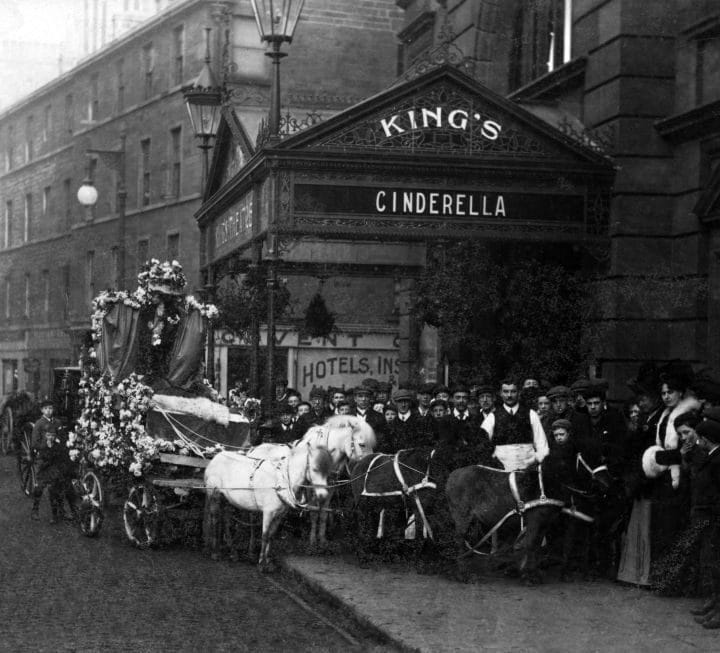
The People's Archive

Meet our volunteers
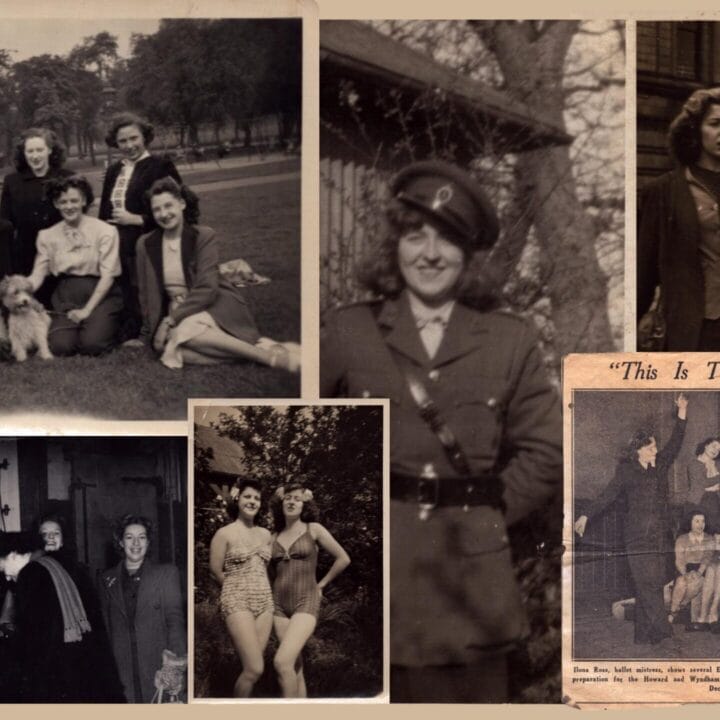
Mary Rose: A variety theatre legacy